



Marketing In Action is for marketers, founders, and business owners who want predictable growth. Learn it, apply it, and get expert help installing the systems that bring in customers and revenue.
In case you missed it (ICYMI), read PiggyVest's Playbook: How a Viral Tweet Led To Over ₦2 Trillion in User Payouts
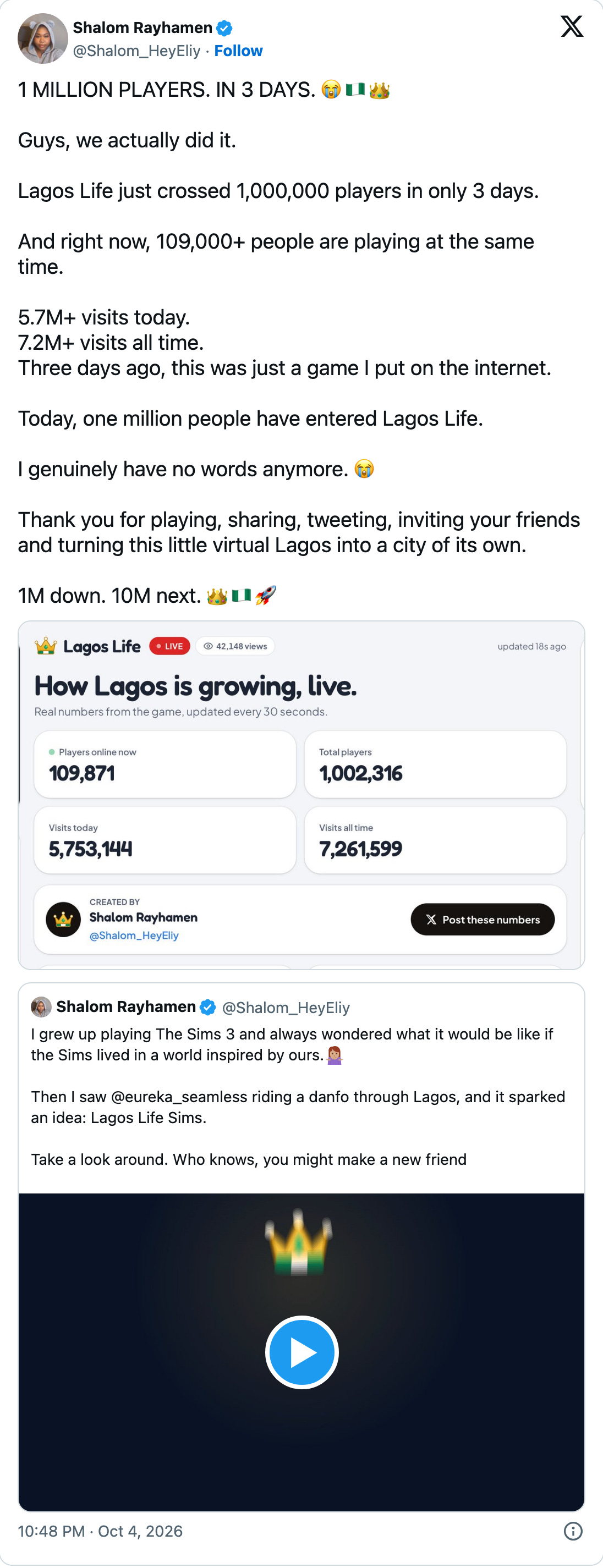
Lagos Life went from a link on X to 1 million players in three days.
A Nigerian developer in the UK built the browser game in under 12 hours. Most marketing teams cannot get a headline approved in that time. It launched on 1 October 2026, and eight days later its company announced $500,000 at a $10 million valuation.
The speed makes it look accidental. I went through the public reports and the posts on X to see what was luck and what was a choice. In another deep dive, we look at how you can build viral loops for your own product, just like Lagos Life. This one looks at what Lagos Life did.
How did Lagos Life reach a million players in three days?
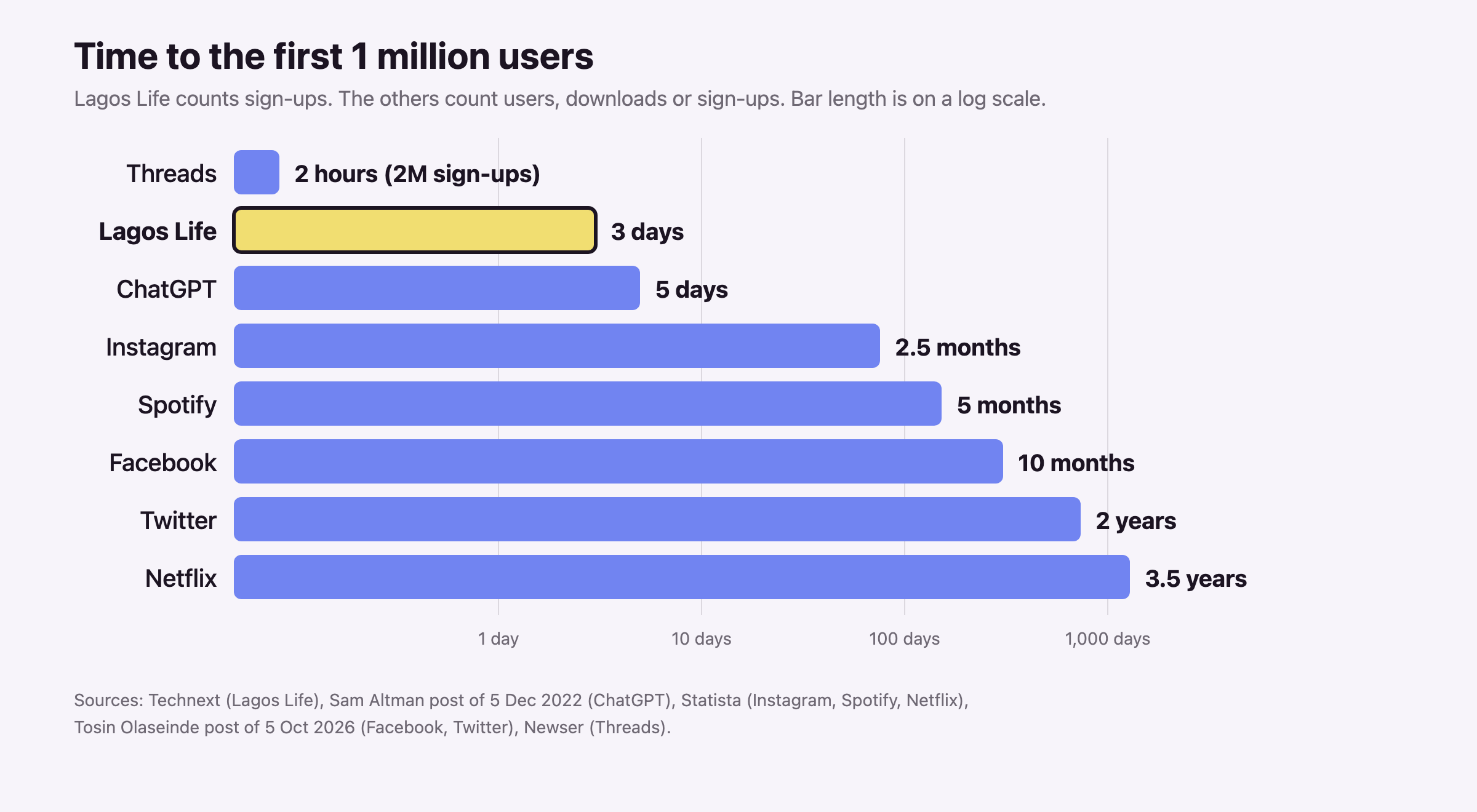
A million users in three days puts a browser game from Lagos next to some famous names. ChatGPT took five days, and it was built by OpenAI. By 2019 it had Microsoft's $1 billion behind it. Instagram took about 2.5 months, Spotify 5 months, Facebook 10 months, Twitter 2 years and Netflix 3.5 years, using the list Tosin Olaseinde (@tosinolaseinde) posted on 5 October. Threads reached 2 million sign-ups in two hours, with Instagram's audience already in its pocket.
Shalom Rayhamen (@Shalom_HeyEliy) had a night, a laptop and a link on X. She learned to code on a Chromebook with light issues and network delays, and her company did not exist yet: TechCabal reports the first round closed three days after incorporation.
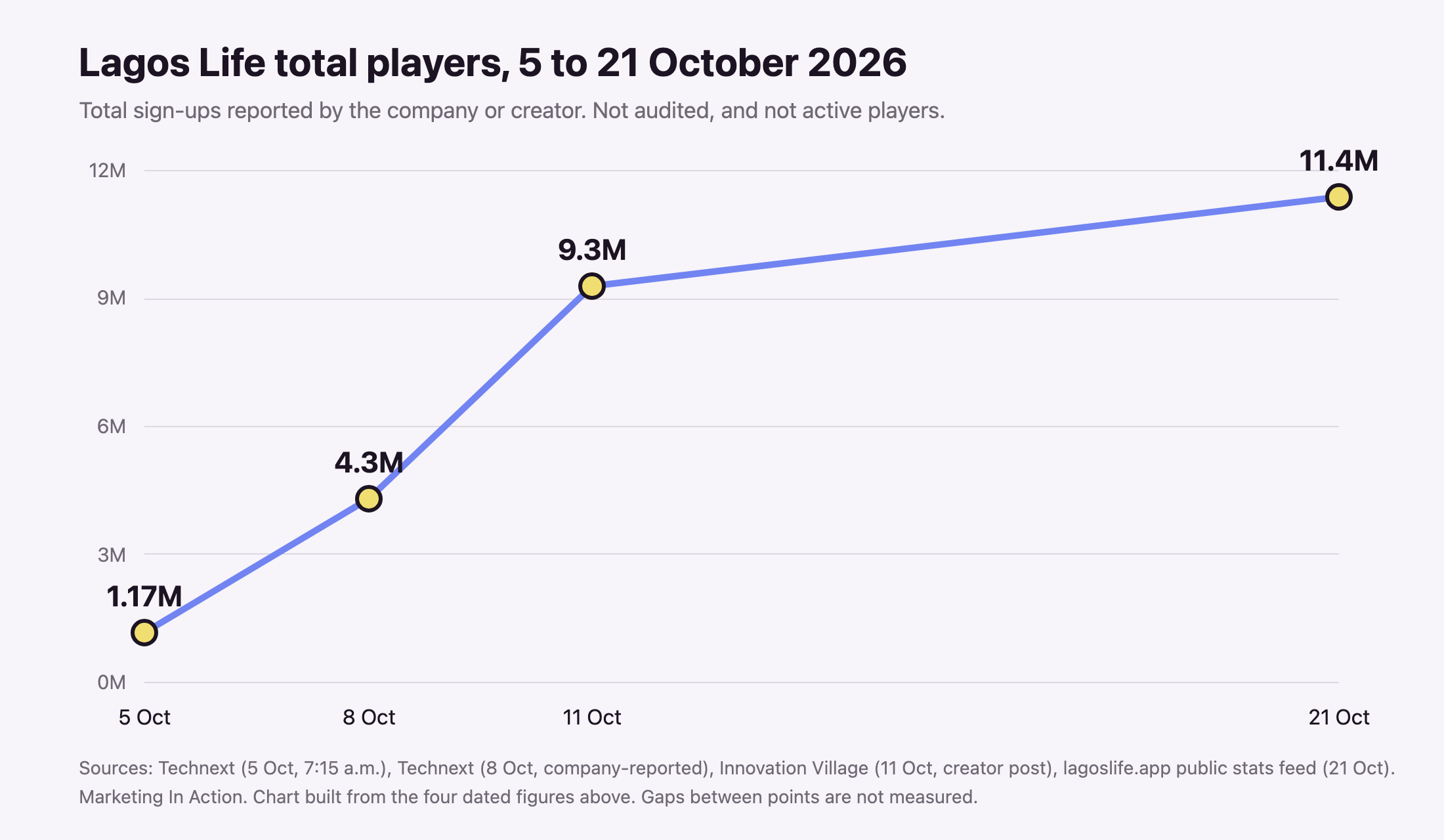
The chart below counts sign-ups for Lagos Life and users, downloads or sign-ups for other products, so it shows how fast people arrived.
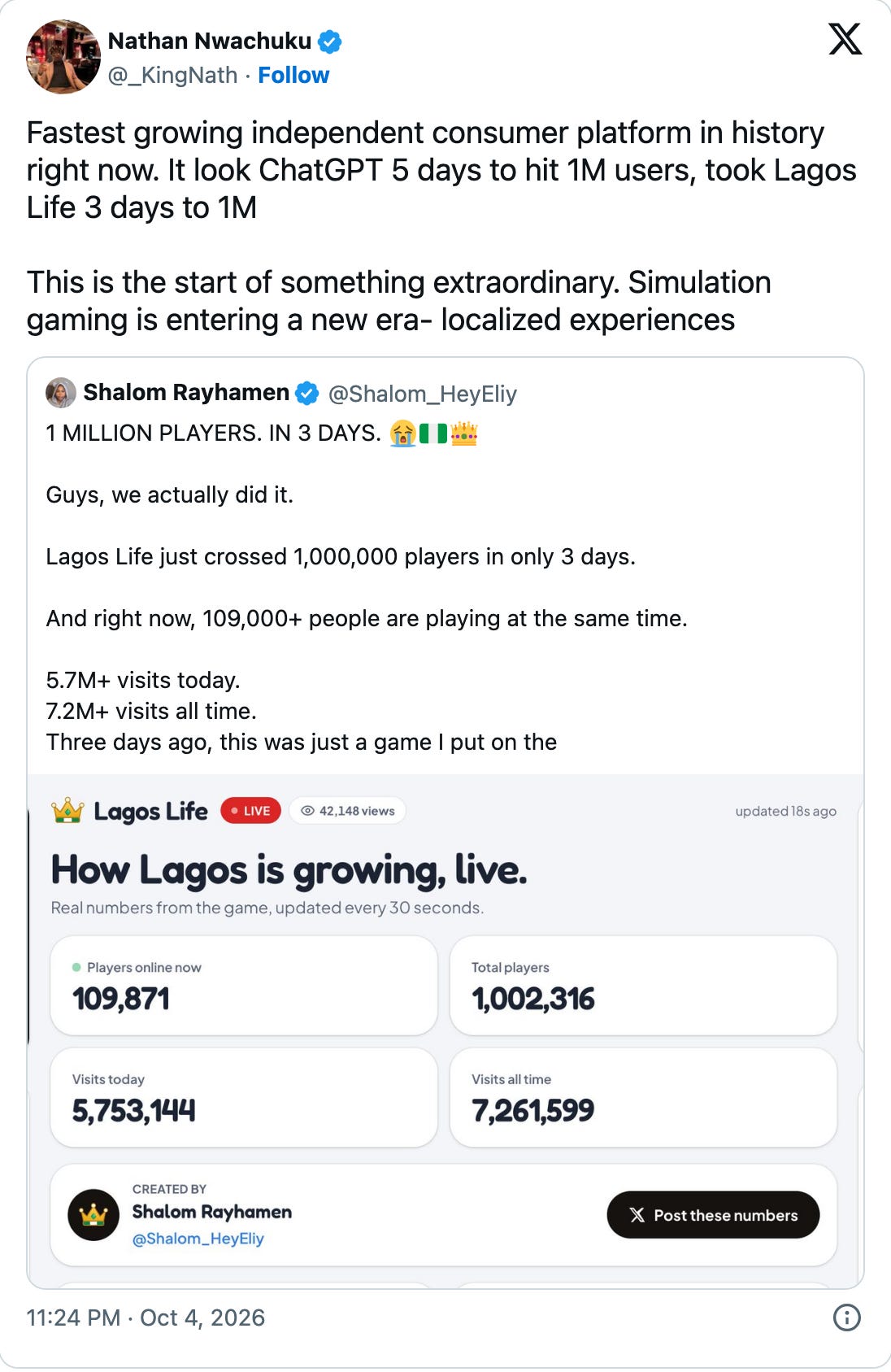
Nigerian X noticed. On 4 October, Nathan Nwachuku (@_KingNath) wrote that it took ChatGPT five days to reach 1 million users and Lagos Life three.
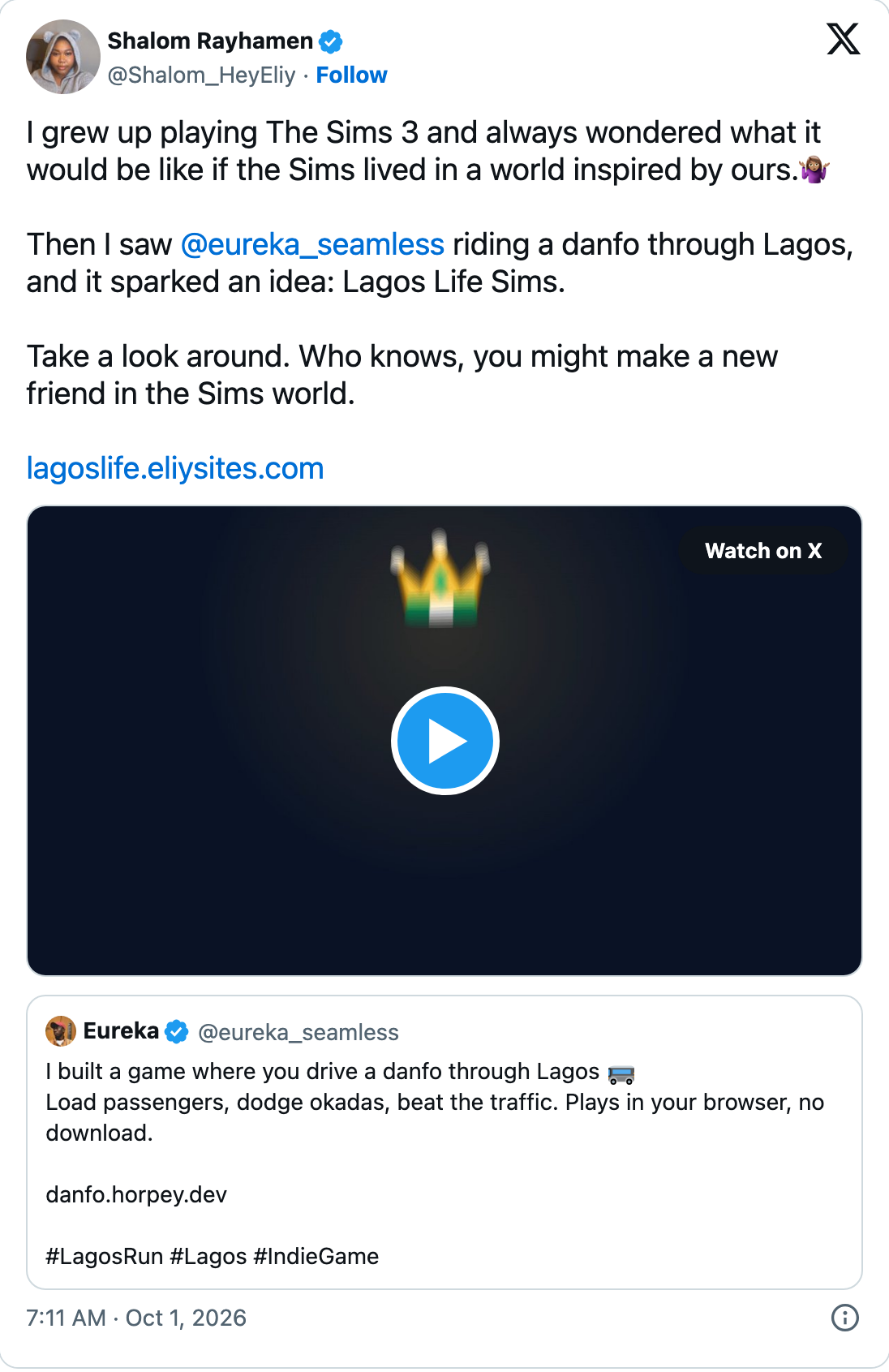
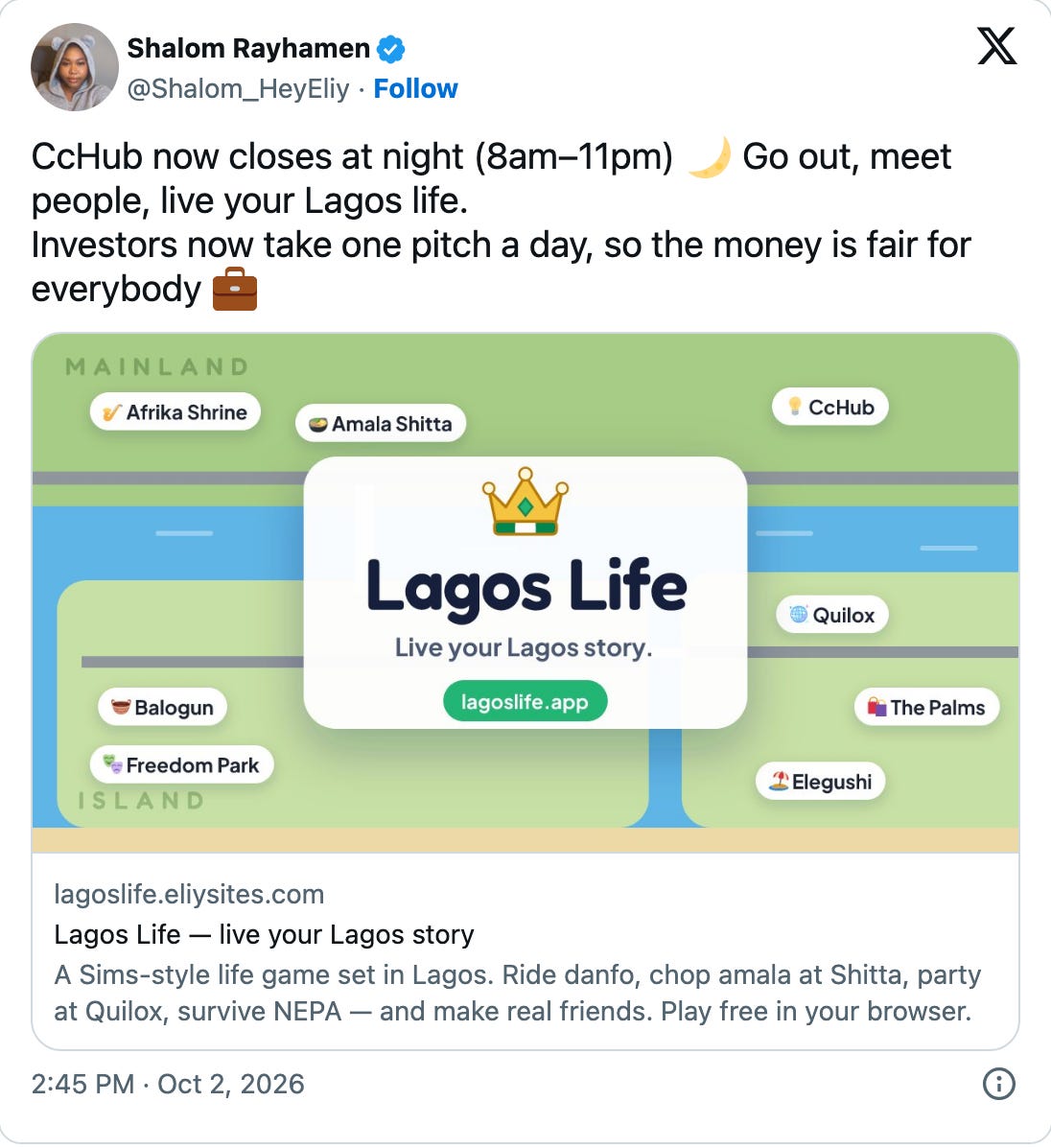
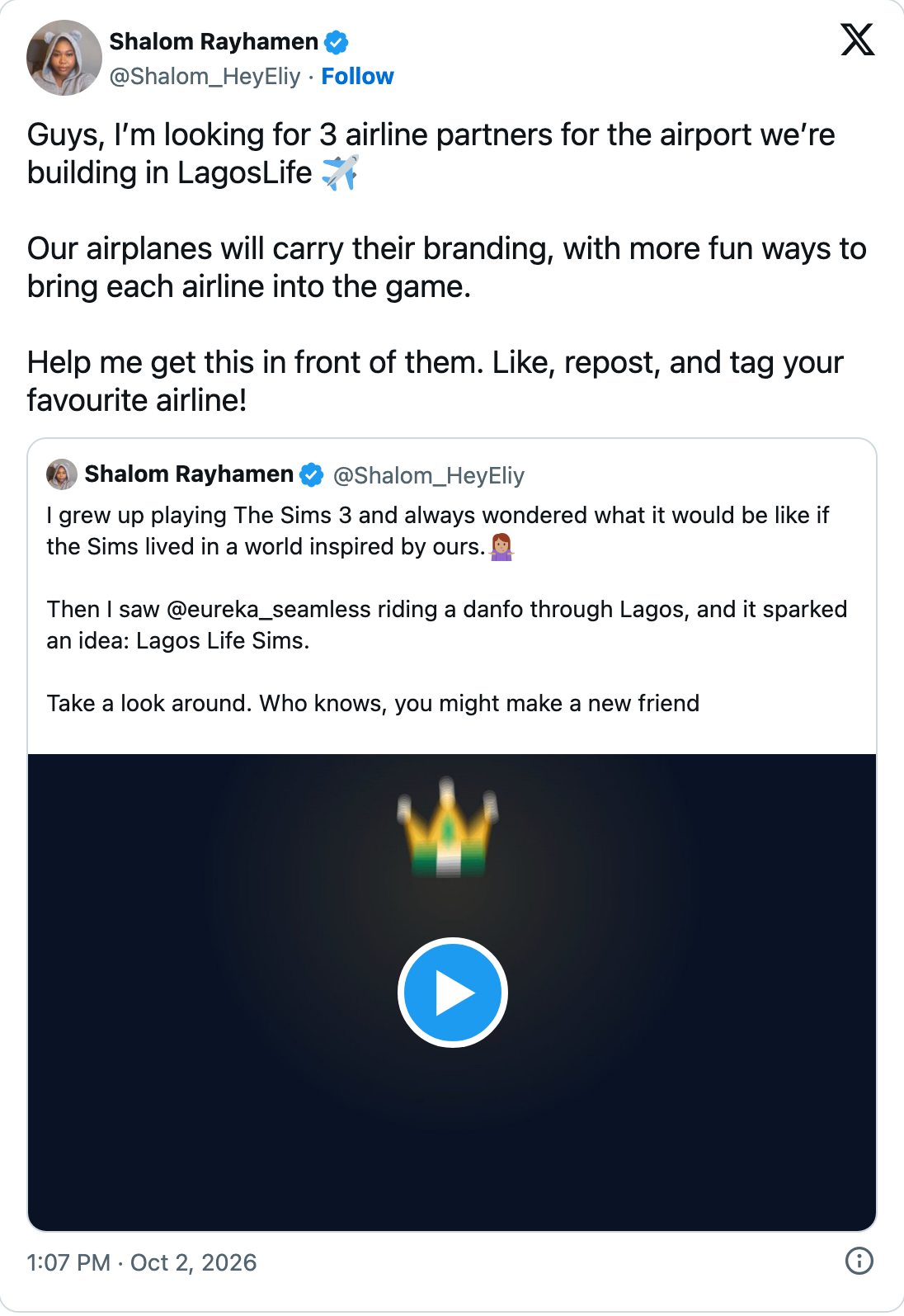
Shalom saw Danfo Run on X and decided to build her own game that evening. Opeyemi Adeniran, who posts as @eureka_seamless, had built the danfo driving game in Berlin. Shalom started at 9 p.m. on 30 September, worked until 5 a.m., napped, and released it at 7 a.m. on 1 October. Her launch post quotes Eureka's clip and gives the idea in her own words: "I grew up playing The Sims 3 and always wondered what it would be like if the Sims lived in a world inspired by ours." The pitch fits in one line: The Sims, set in Lagos.
Players start life as a Nepo baby or a Lapo baby, placed by a random draw. To the uninitiated, in Nigeria, a nepo baby is the child whose family's money and connections open doors. Lapo comes from LAPO Microfinance Bank, known for small loans to market traders, so a Lapo start means you begin broke, on a loan, and hustling. Every Lagosian has an opinion on who is really a nepo baby, and the game settles it with a random draw. From there players take jobs that use up energy and spend at places like Amala Shitta and Quilox. It opens in a browser, and Technext says players join through a link shared on X or TikTok, with no download and no app store.
The numbers came fast. Technext counted 1,173,086 players at 7:15 a.m. on 5 October, and the company reported 4.3 million from 15 countries by 8 October. Technext puts the first million at three days, while Techcrier quotes the developer as saying four. Either way, it took less than a week.
Check out the MIA Academy, where modern marketers learn applied product marketing, growth, GTM, and AI skills taught through real execution, feedback, and systems you can use at work.
Was Shalom Rayhamen an overnight success?
No. Zikoko's 7 October profile traces her story back eight years. She took a six-month coding internship in Abia State in 2018, then taught herself in tech hubs that had free Wi-Fi and light. In 2020 she earned ₦60,000 for building the front end of a medical booking app. A stranger saw her posts on Facebook, and in 2021 she had a remote job at $1,000 a month. In 2023 she received a UK Global Talent visa. TechCabal reports nearly a decade of JavaScript experience.
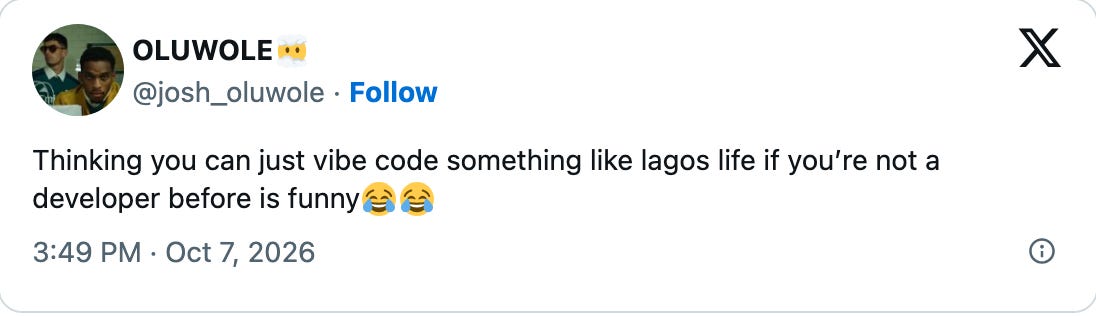
She told Zikoko that her earlier personal projects never did well for long, and that she was thinking of quitting them just before Lagos Life. Oluwole (@josh_oluwole) made the same point on 7 October: a non-developer cannot simply vibe code something like this.
TechCabal reports that she used AI for research and coding through Anthropic's API. She said, "I'm pro AI... I know how to use AI to my advantage." Technext says Eureka used Claude and AI-generated graphics for Danfo Run.
The night took eight hours. The years before it explain why those hours worked. A classic example of how a moving (wo)man will meet their luck.
How did Danfo Run and Lagos Life treat money differently?
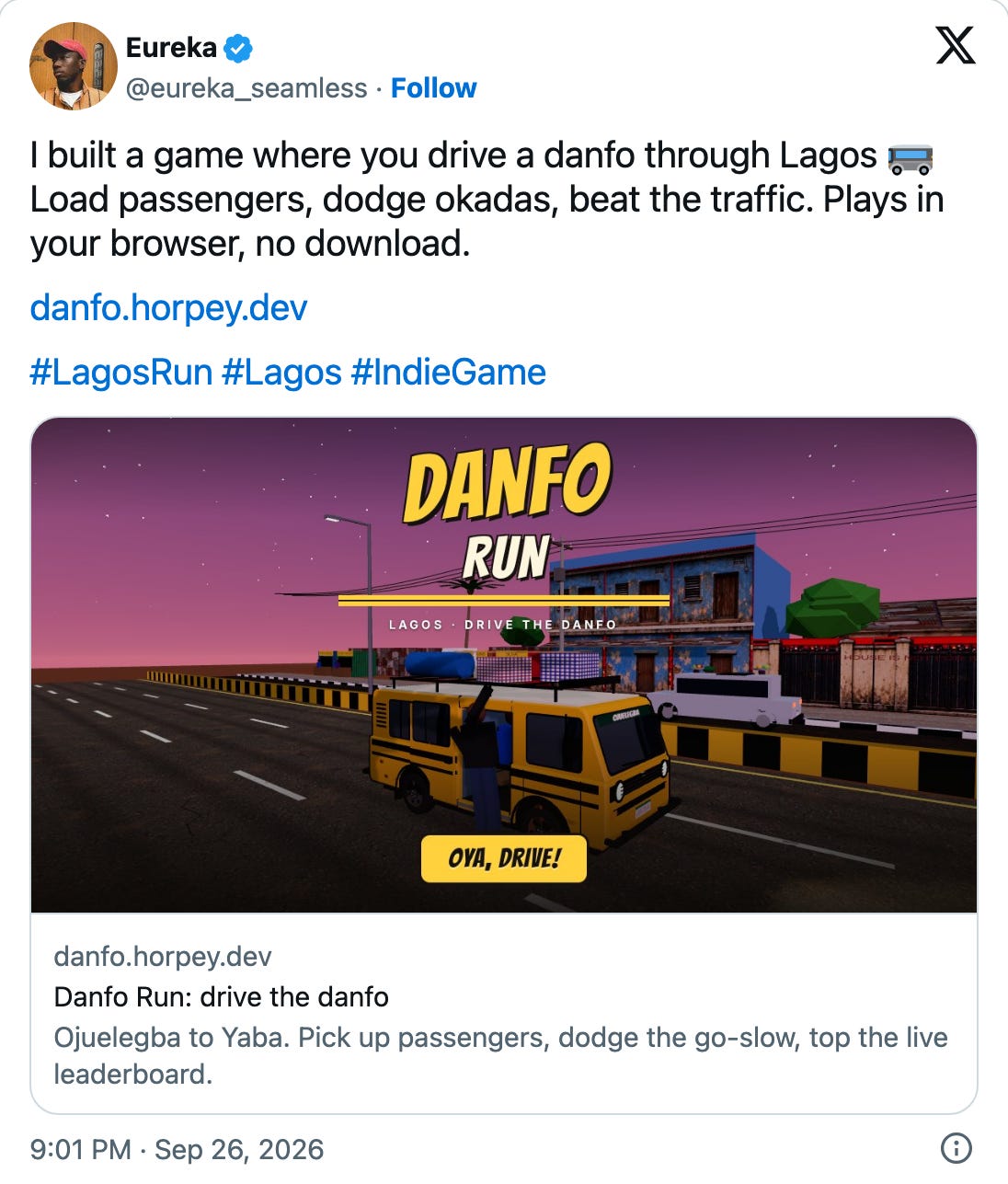
Eureka released Danfo Run with a launch post on 26 September, under the hashtag #LagosRun, after four to five weeks of spare time. The post has since passed 14 million views. Technext counted 7,000 players in two days, and IsaKaba later reported more than 140,000 in week one, from 145 countries. He told IsaKaba, "Honestly, I expected a few hundred people to play it and laugh."
His money choice was clear. On 30 September he posted: "The game stays free. Drop a Chapman and help bring agbero into the game." The goal was ₦250,000. On 27 October the fundraising page showed 12 supporters and 6,770 views. He told IsaKaba that any revenue would come from brand partnerships that "fit naturally into a Lagos street", and BusinessDay reports no revenue for Danfo Run.
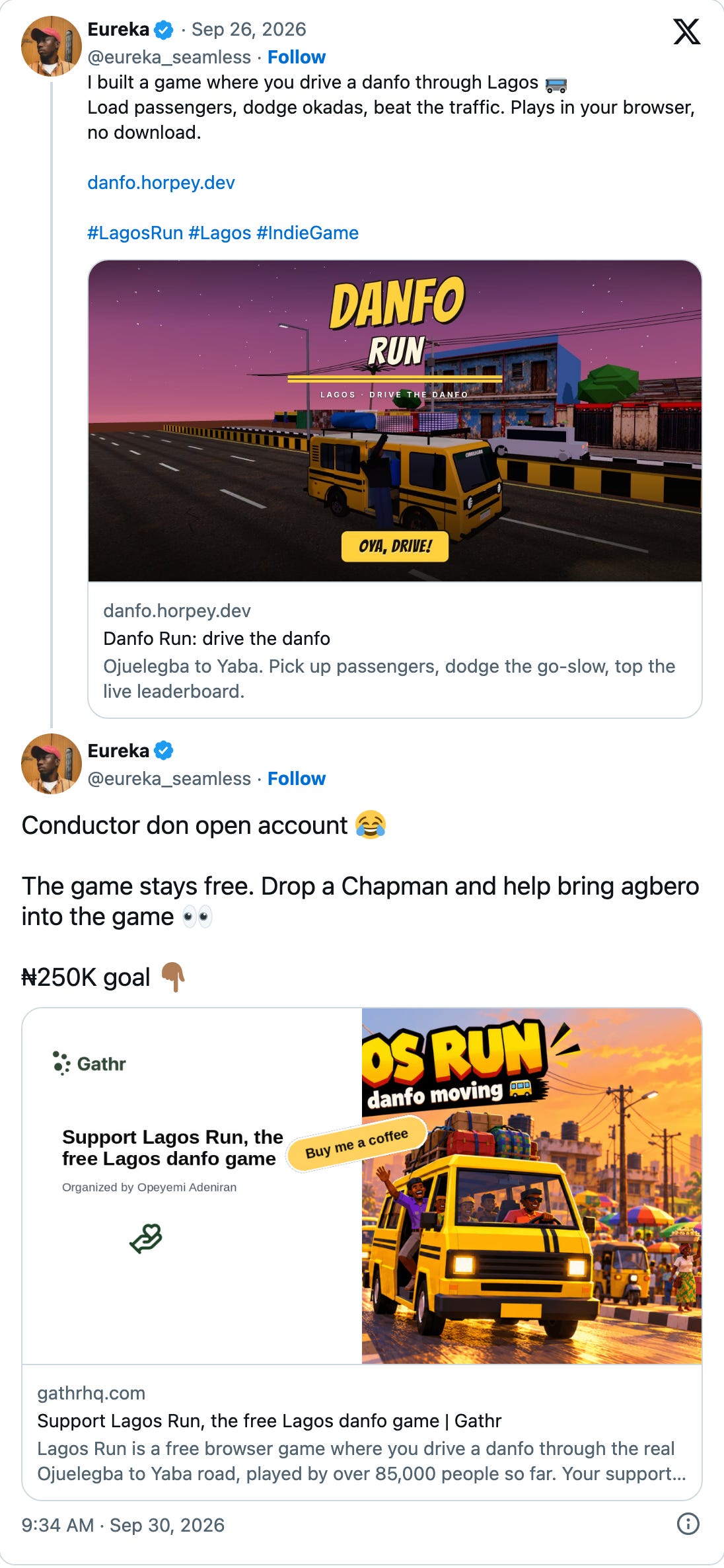
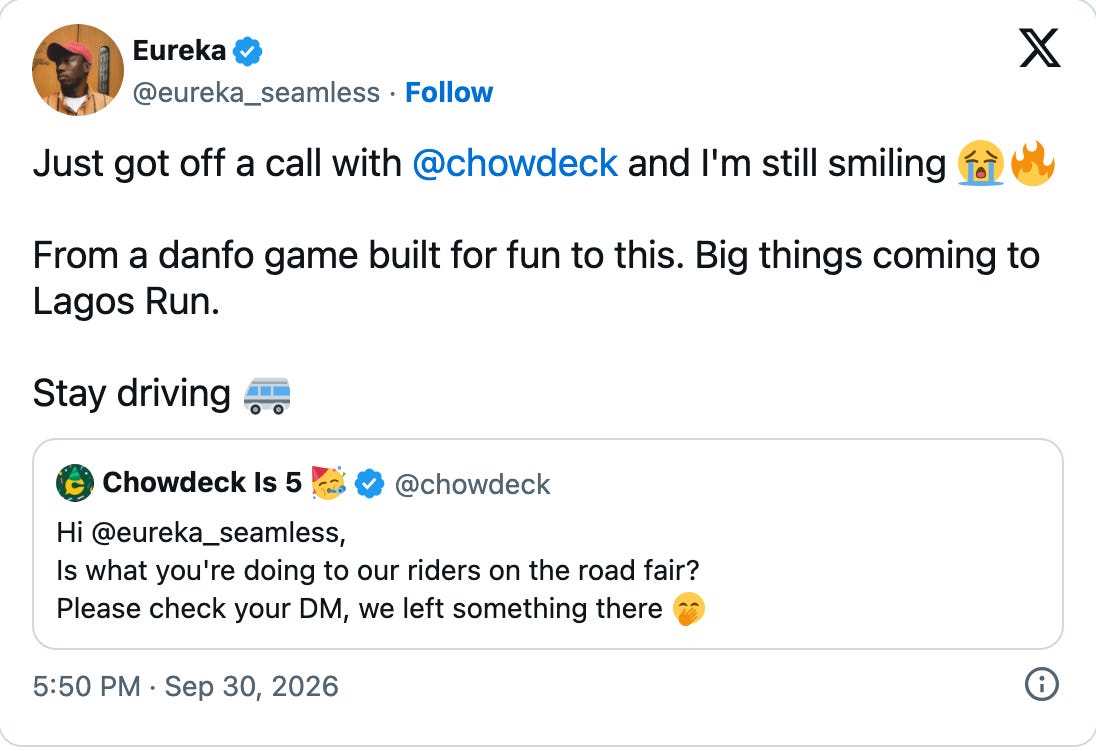
The same day, he posted that he had just got off a call with Chowdeck (@chowdeck) and that big things were coming to Danfo Run.
Lagos Life launched the next morning with a more direct plan. Shalom credited Danfo Run in her launch post, then sold ad space within days. She told Zikoko, "I had to scale up my game to accommodate more ads." Neither choice is wrong. Eureka protected a free game and wants to "grow into a proper games studio". Shalom put a price on attention in week one.
What helped Lagos Life spread so quickly?
Danfo Run is a single-session game: you play, post your score and leave. Technext describes Lagos Life as a persistent multiplayer world where players meet, chat, buy land and visit clubs. A world with other people in it gives a player a reason to send a link. Danfo Run runs on a challenge loop, where a score dares a friend to beat it, and Lagos Life adds a recruit loop, where a friend makes the world better.
Players describe it the same way. Dreamgirl, a player, told Communiqué she stayed for "the ability for the game to be diverse, in the sense that you can interact with people." Counsellor Vincent Ehindero offers sessions in the world. "I was trying to create this safe environment for them where they also want to speak," he said, and he counts more than 40 paid sessions.
The invitation to meet people was in the pitch from day one. Her launch post ended with "you might make a new friend", and on 2 October she wrote: "Go out, meet people, live your Lagos life."
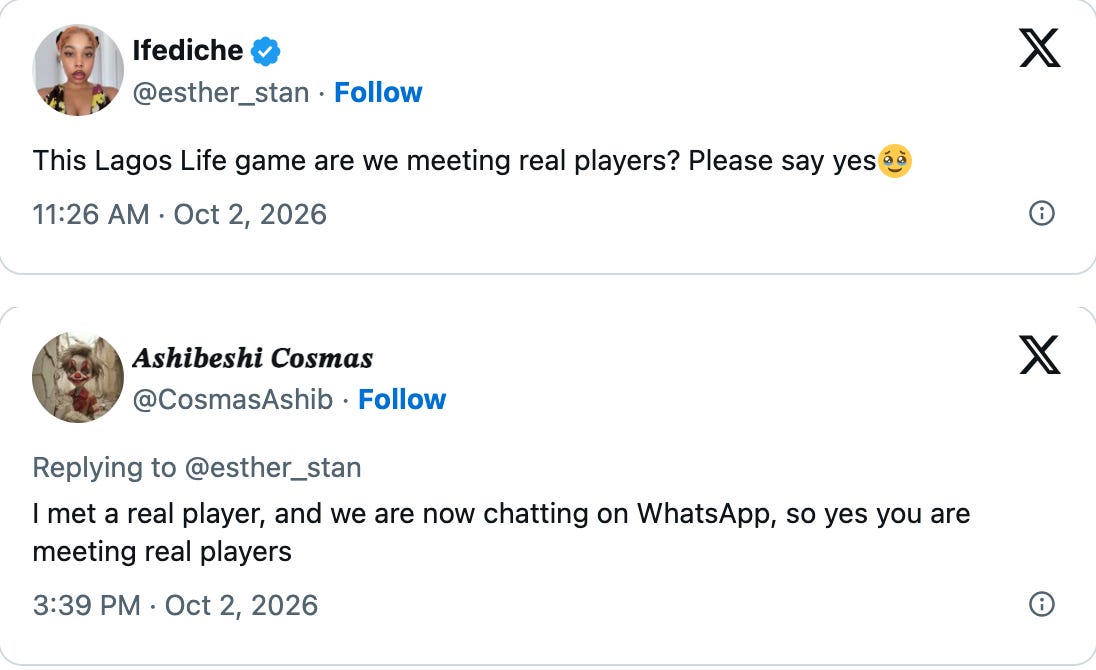
The product promised friendship, and players tested the promise. Ifediche (@esther_stan) asked on 2 October, "This Lagos Life game are we meeting real players? Please say yes". @CosmasAshib replied: "I met a real player, and we are now chatting on WhatsApp, so yes you are meeting real players". On 3 October, @bebeidiyonce asked whether having a bae on Lagos Life counts as cheating, because "these are also real people".
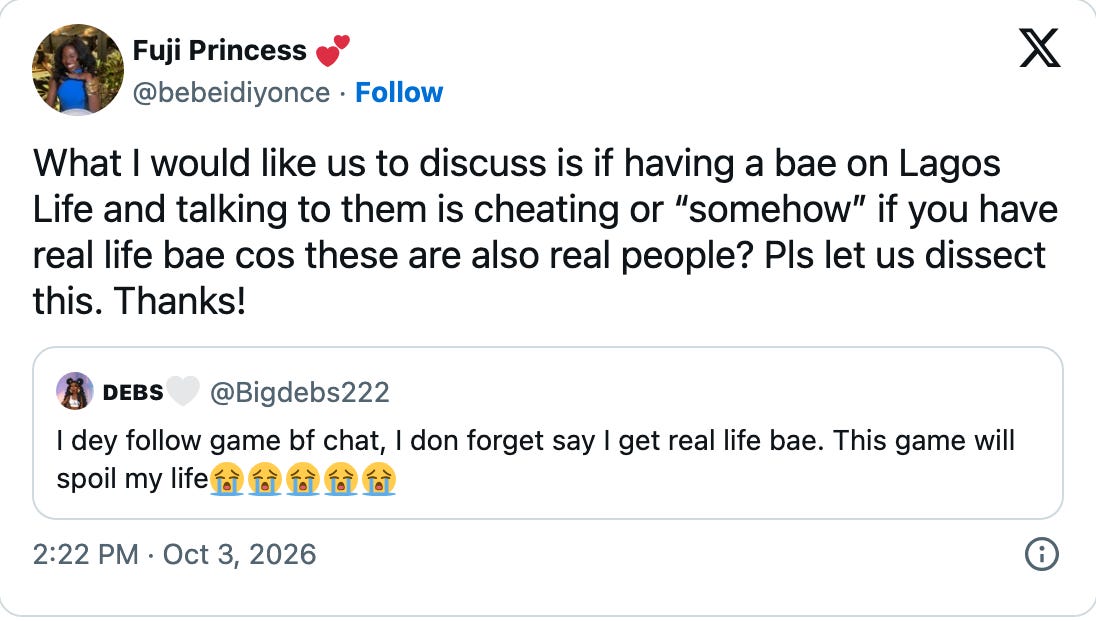
These posts show demand for company, and the world is built to supply it. Contact is not always welcome. Divine Favour wrote on Substack that she blocked people over inappropriate requests, and Shalom told TechCabal, "We screen and censor messages."
How fast did Shalom keep shipping after launch?
The speed did not stop at launch.
2 October: an outage, then ₦100,000 in virtual cash for every player. That morning she announced Abuja, Port Harcourt and an airport.
6 October: the official account (@LagosLifeApp) said Abuja, Port Harcourt and the airports went live, with savings and bonds, a home in every city and a help guide.
7 October: after players asked, ₦10,000 and ₦20,000 top-up packages arrived.
14 October: players could subscribe to real Dangote Refinery shares from inside the game.
18 October: the governorship party primaries began.
Not every fix landed softly. A script meant to catch criminals wiped everyone's money by mistake. She told Zikoko, "People were pissed, even insulting me on Twitter, but that's okay."
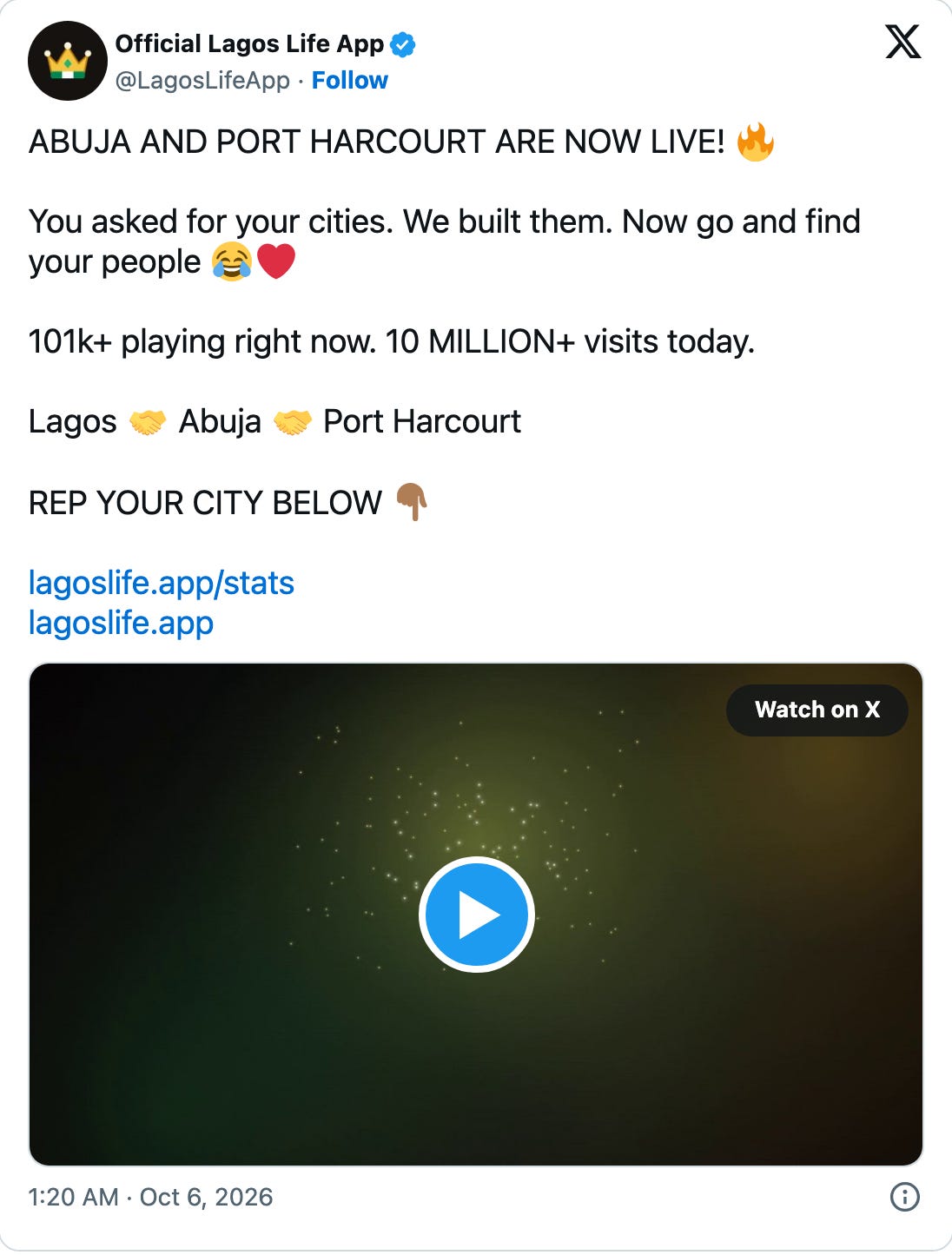
She built in public the same way. She posted milestones with numbers, such as $46,900 in revenue in four days, and thanked ad buyers one by one. She also asked followers to like, repost and tag their favourite airline for an airport that did not exist yet. She uses AI agents to collect player requests from social media and sort them into bugs, urgent fixes and new features, and she told TechCabal the agents are expensive. She also accepts the cost of changing things: "You release features, and some people will say 'yay' and some people say 'nah'."
Favour Yusuf (@FavourYusuf1) went through the posts about both games for his breakdown on X and counted 231 posts from Shalom against 86 from Eureka. He also pointed to a button on her public stats page that said "Post these numbers", so players did the announcing for her. By his count, posts about Danfo Run peaked around 29 September and fell away. Posts about Lagos Life kept climbing, and on the afternoon of 4 October he counted 20 in under a minute.
How does Lagos Life make money from a free game?
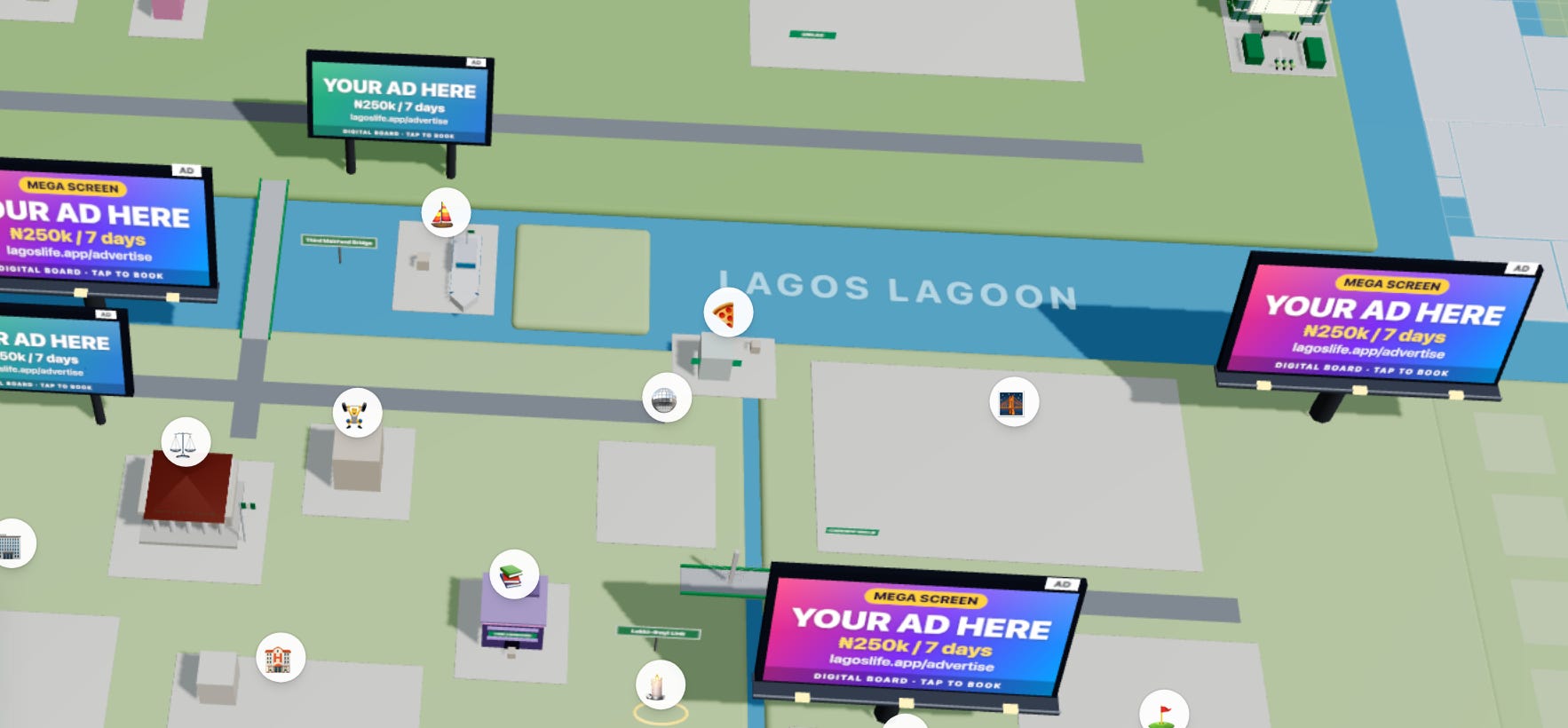
It sells advertising inside the game. As of 27 October 2026, the advertise page lists 20 digital billboards at ₦250,000 each for seven days, 6x6 sea plots at ₦18,000 each, and 10 airport boards at ₦500,000 each.
The prices moved fast. Techcrier listed roadside billboards at about ₦5,000 a week, Techpoint saw ₦50,000 on 5 October, and today (27 October 2026) it is ₦250,000, 50 times the first price Techcrier listed. Sea plots moved the same way. Favour Yusuf recorded them starting at ₦100, and the advertise page now lists them at ₦18,000.
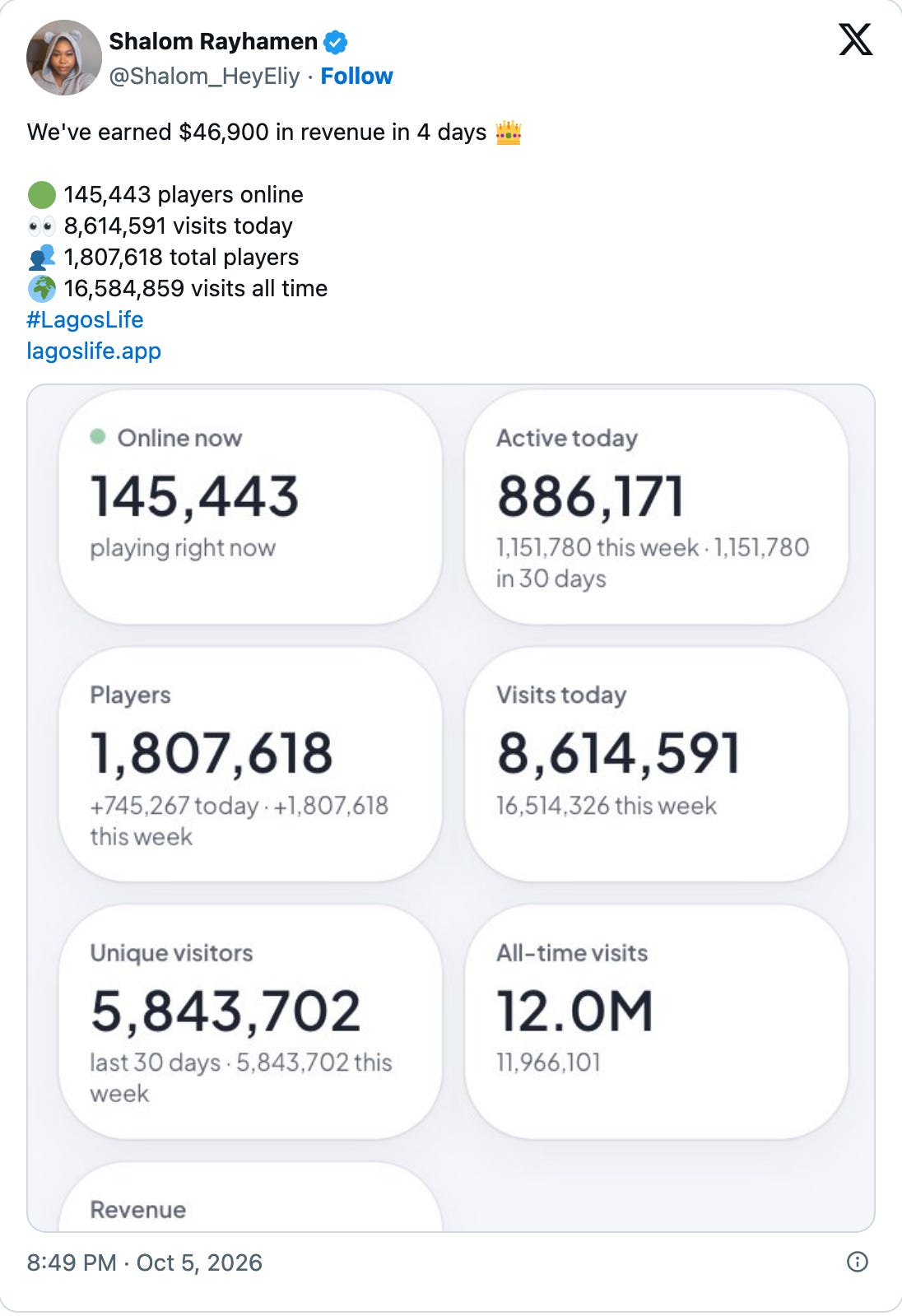
The developer posted about $46,900 in revenue for the first four days, and by 9 October the company said it had more than $170,000 "earned and contracted". Techpoint notes that the second figure mixes cash with signed deals.
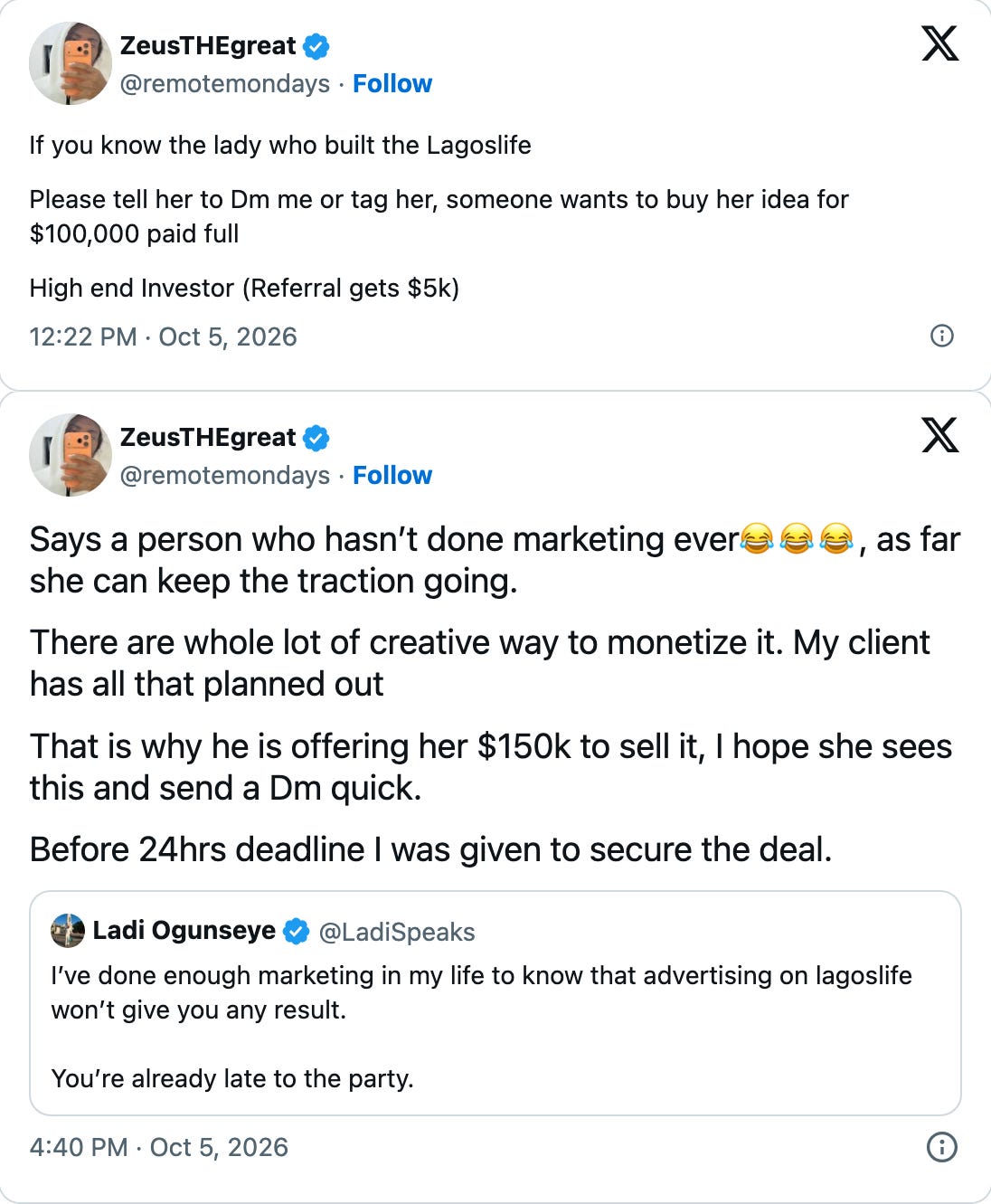
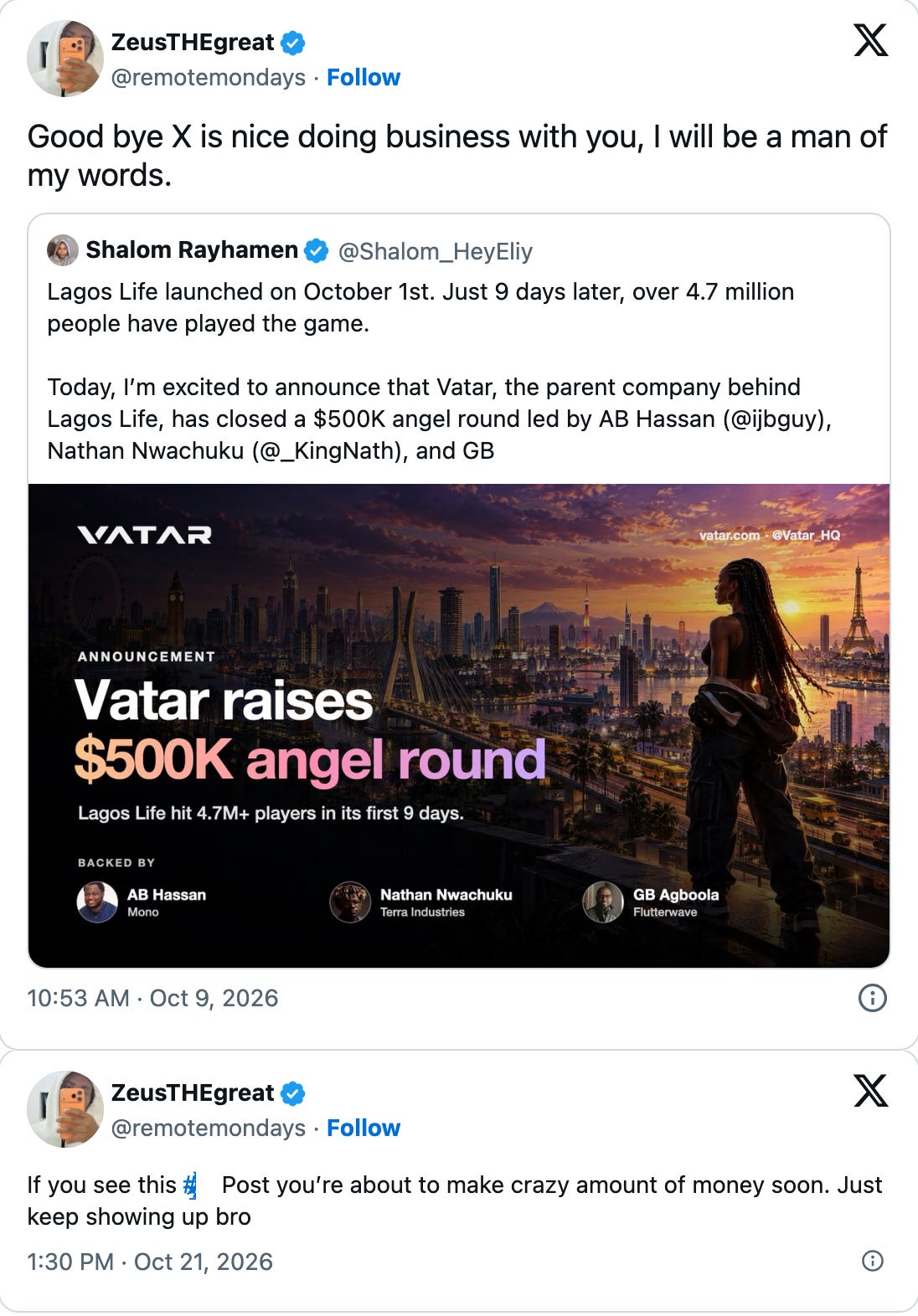
The first figure has a story, and it starts with a buyer. At 12:22 p.m. on 5 October, ZeusTHEgreat (@remotemondays) posted that "someone wants to buy her idea for $100,000 paid full", with $5,000 for whoever made the introduction. The post passed 1 million views. Vincent (@janvinsha) did the maths in public: "$100k for 1m users? Lmao". By 4:40 p.m. the offer had become $150,000, with a "24hrs deadline" and a dig at Ladi Ogunseye as "a person who hasn't done marketing ever". A price that rises 50% in four hours is usually called a bidding war. This one had one bidder.
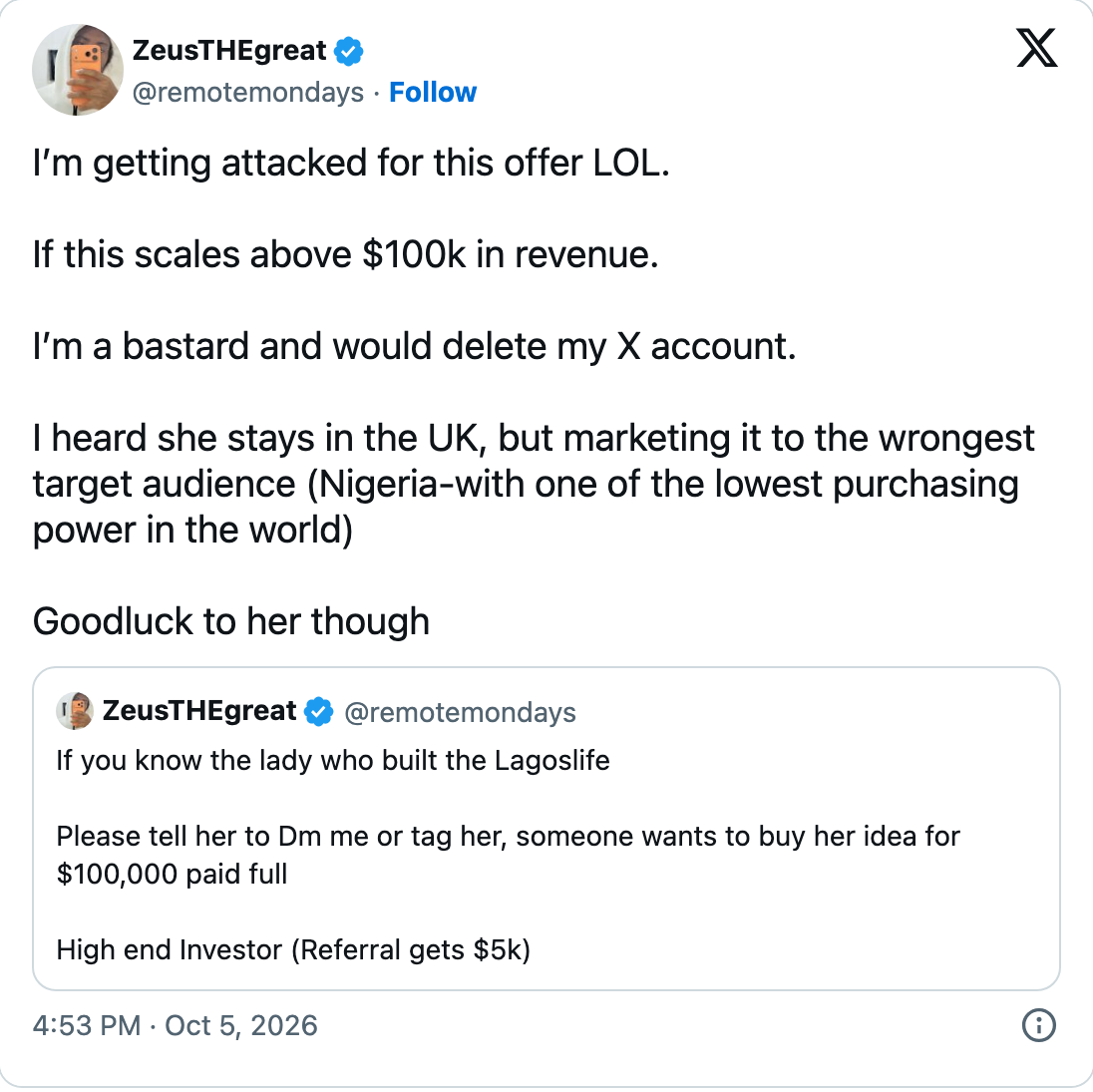
Thirteen minutes later he raised the stakes on himself. "If this scales above $100k in revenue", he wrote, he would delete his X account, because she was marketing to Nigeria, "one of the lowest purchasing power in the world".
Shalom told Zikoko she found it hilarious that he valued the company so low. At 8:49 p.m. the same day she answered with a number. "We've earned $46,900 in revenue in 4 days", she posted, with the live dashboard underneath. Four days of sales had covered almost half of his offer. The offer priced the attention, and her reply priced the business.
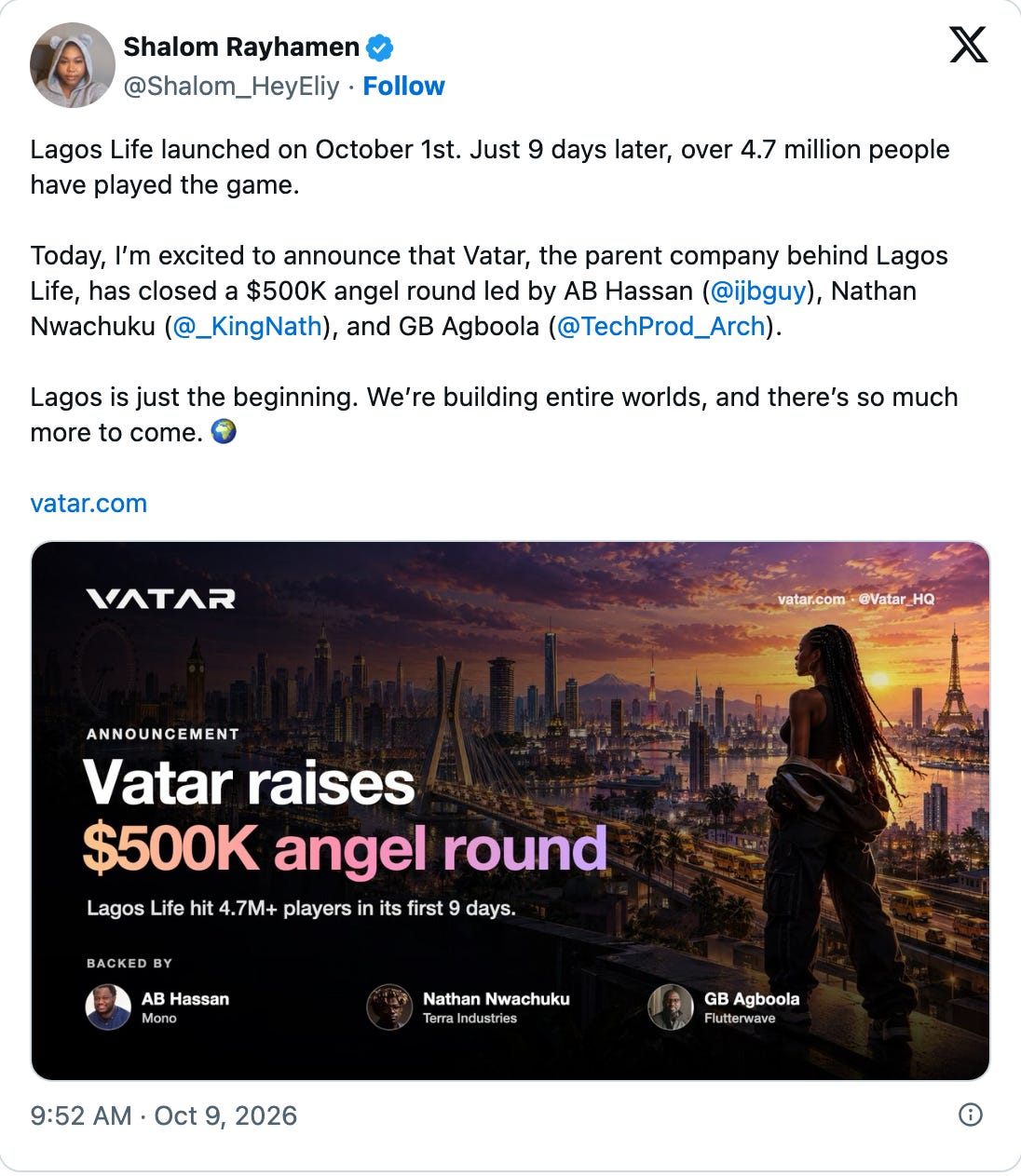
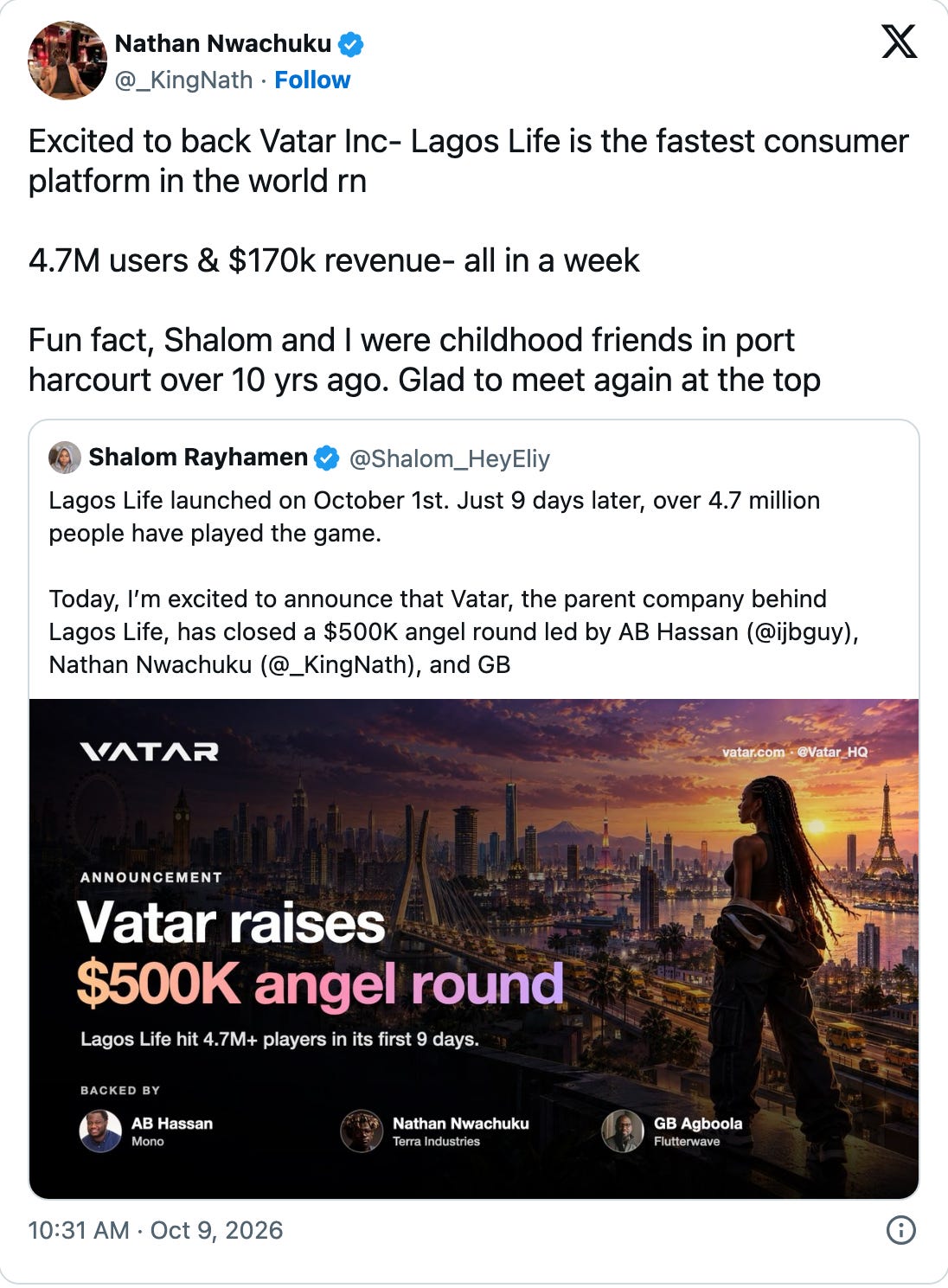
On 9 October, Vatar Inc. announced $500,000 at a $10 million valuation, roughly 5% of the company, and reports say the round opened and closed within a day. Her announcement named AB Hassan (@ijbguy) of Mono and Nathan Nwachuku (@_KingNath) of Terra Industries, plus GB Agboola (@TechProd_Arch) of Flutterwave through his fund Resilience17. Oo Nwoye (@OoTheNigerian) also invested.
On 9 October, Nwachuku wrote that he was "excited to back" Vatar and called it "the fastest consumer platform in the world rn". He added that he and Shalom were childhood friends in Port Harcourt.
ZeusTHEgreat saw the same announcement. On 9 October he quoted it: "Good bye X is nice doing business with you, I will be a man of my words." Victor Filani (@victorfilani77) replied, "Guy no need to deactivate your account. we forgive you." The forgiveness was not needed for long. On 21 October he was still posting, telling his followers to "keep showing up".
Which brands rented attention inside Lagos Life?
Brands used the game as a place to meet customers.
Salary Index (@salaryindexng) went onto every player's phone on 2 October. A refreshed logo post on 5 October drew 18,819 views.
Chowdeck became an app on the in-game phone around 9 October, where players order meals with in-game money. Chowdeck is the subject of an earlier MIA case study on how Chowdeck grew.
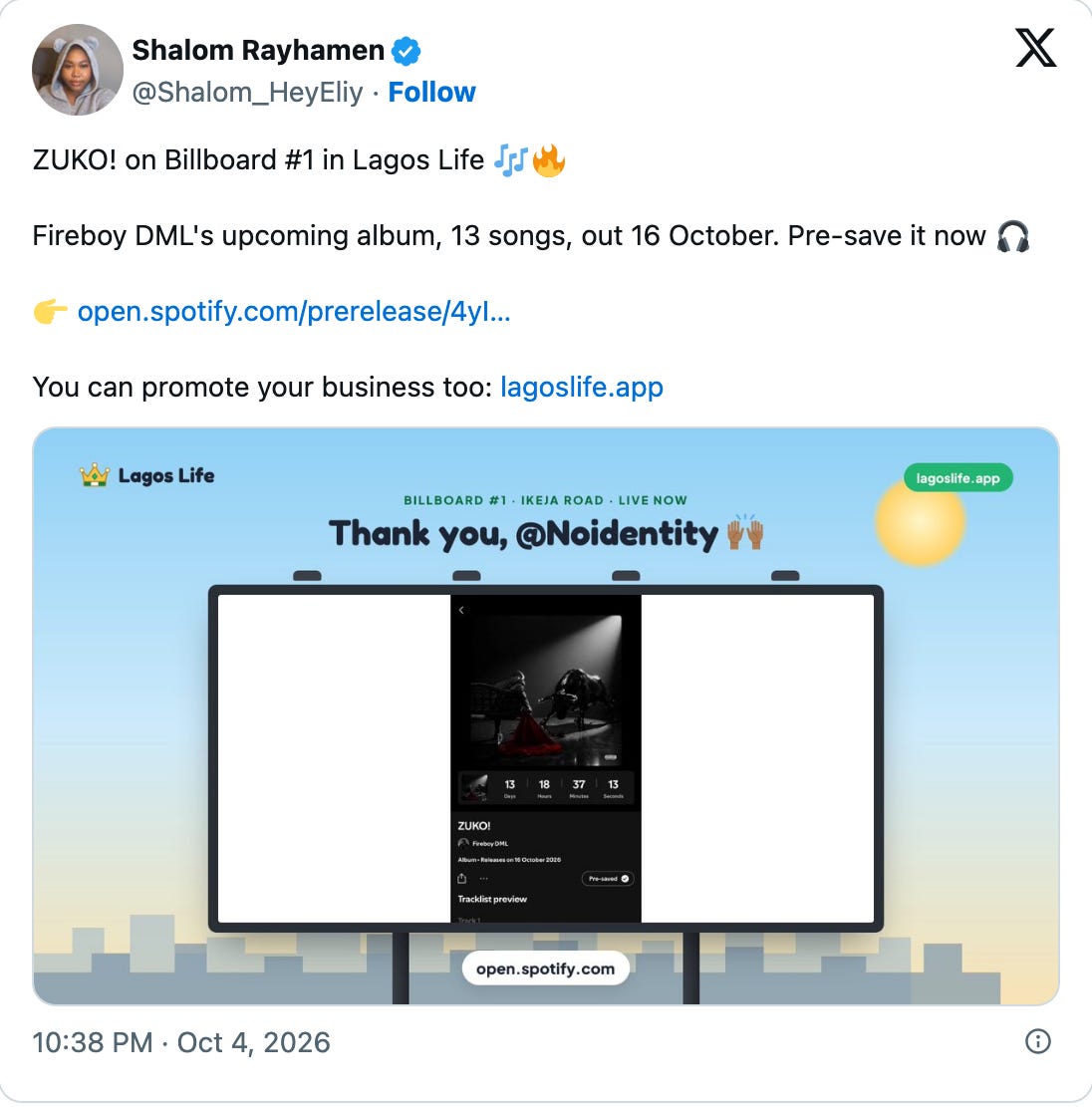
Fireboy DML's album ZUKO! (@fireboydml) went on Billboard 1 on 4 October with a pre-save link, 12 days before release. Aice (@jesurhobo) posted that he bought all the billboards, and the post drew 72.9K views. On 20 October the official account put players in the DJ booth at Quilox.
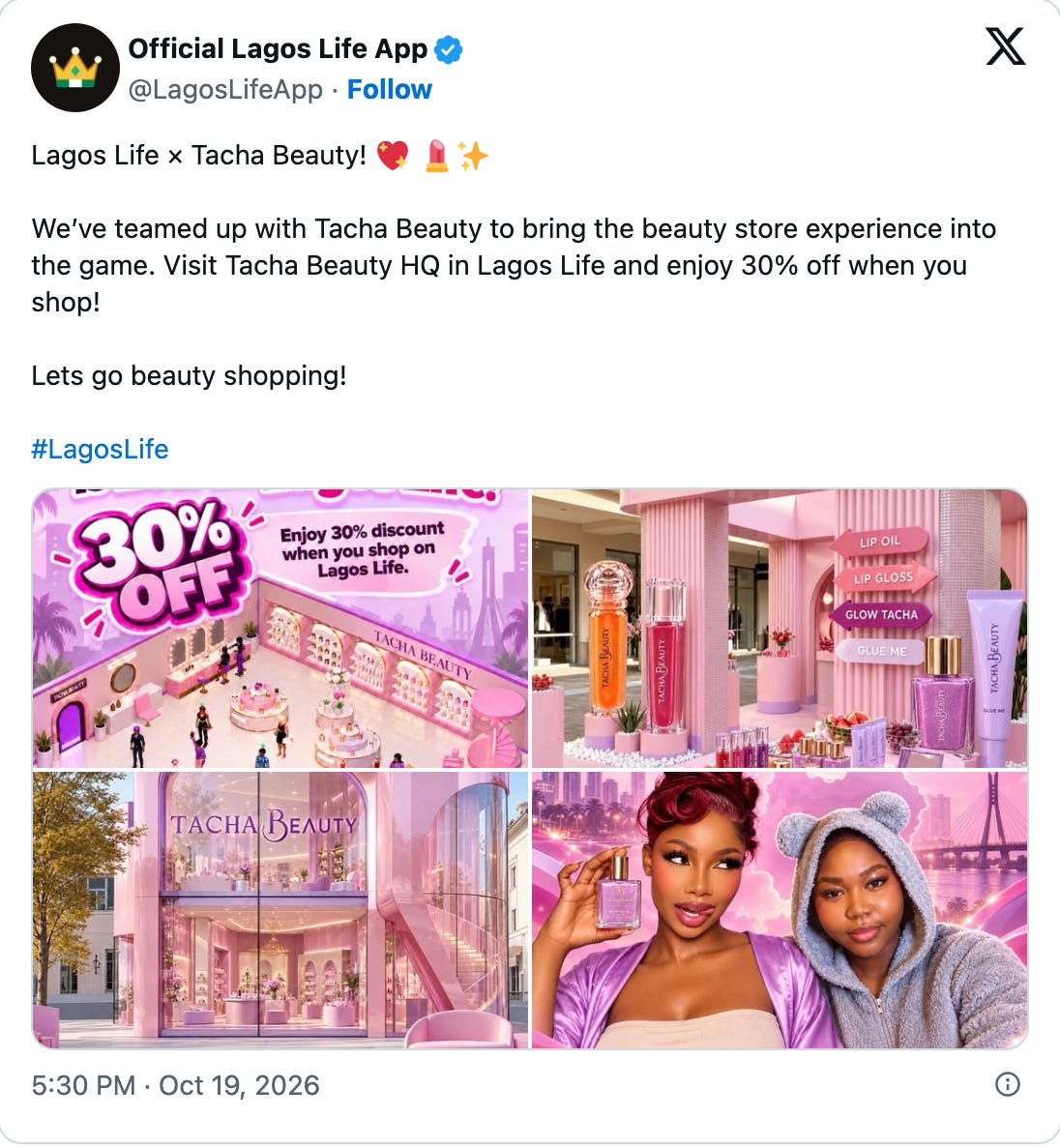
Tacha Beauty (@tachabeautyhq), the beauty brand of Tacha (@Symply_Tacha), opened a store inside the game. Players found it before the official announcement: on 17 October, Adedolapo (@Dollysylph) posted screenshots of Tacha Beauty HQ in Lagos Life with the line "this is why I love her". Two days later the official account announced Tacha Beauty HQ with 30% off for anyone who shops in the game. The customers did the teaser campaign for free.
Tele x Zikora, a film, ran a billboard hunt on 8 October through Adeoluwa Akintoba (@adeyybasqi): find the board, screenshot it, tag the page, win a ticket.
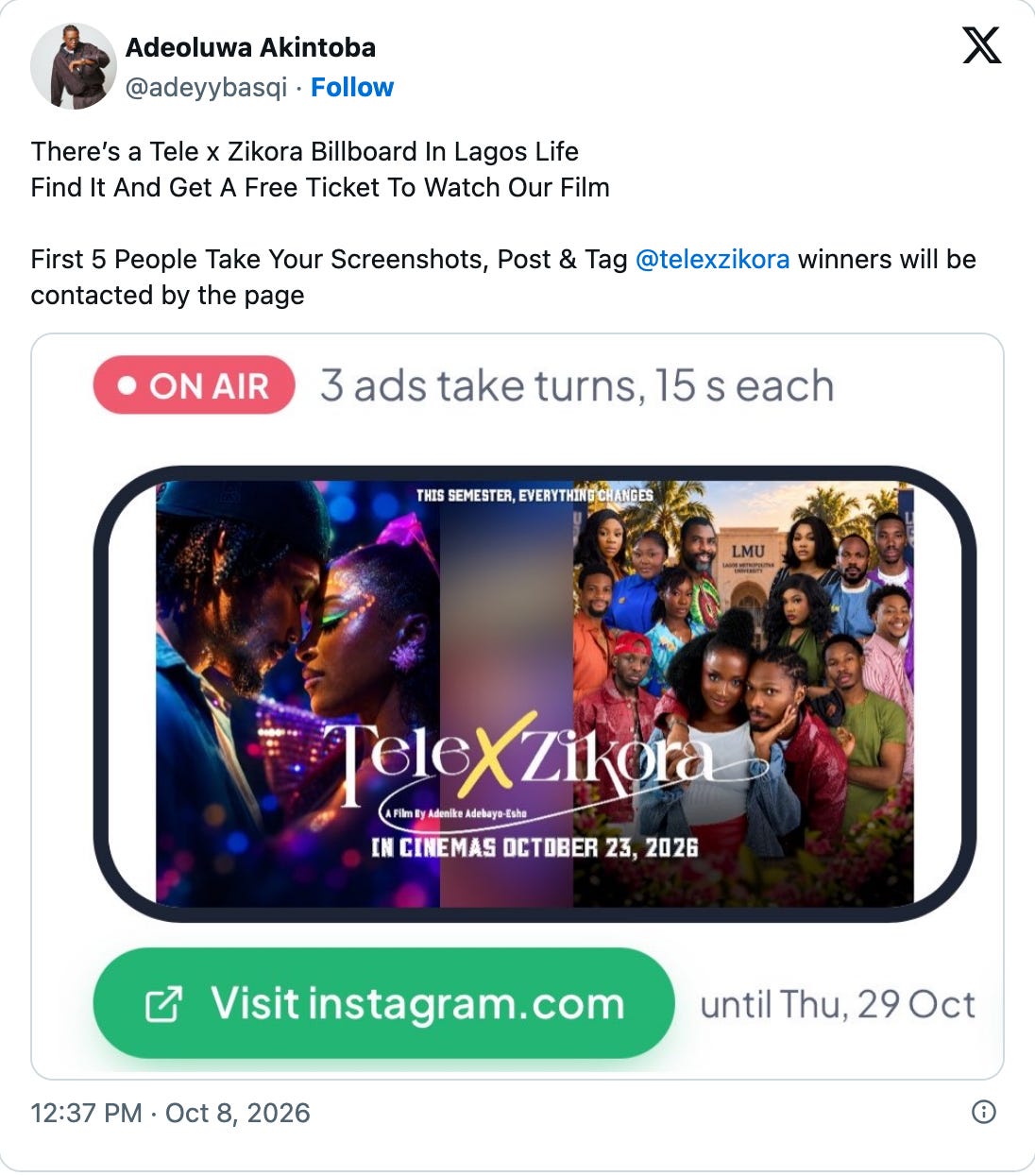
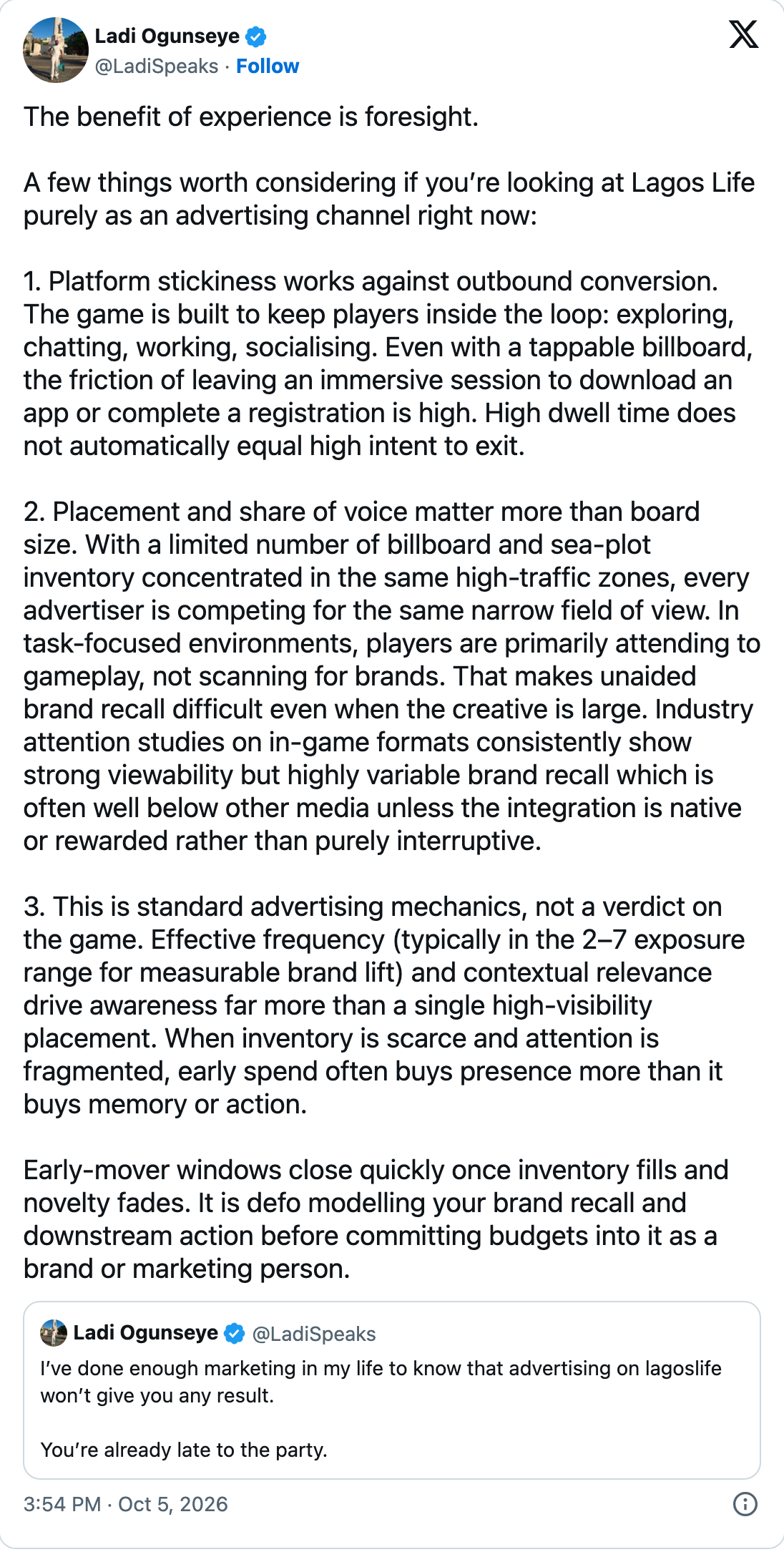
Marketer Ladi Ogunseye (@LadiSpeaks) argued on 5 October that "Platform stickiness works against outbound conversion", and that "Placement and share of voice matter more than board size." The hunt and the DJ booth give players something to do. A plain board gives marketers another logo placement to report.
Share this with a founder or marketer on Twitter | LinkedIn | WhatsApp. It takes me 20 hours to write this. Sharing will only take 20 seconds.
What did the hype bring along with it?
First came the founders.
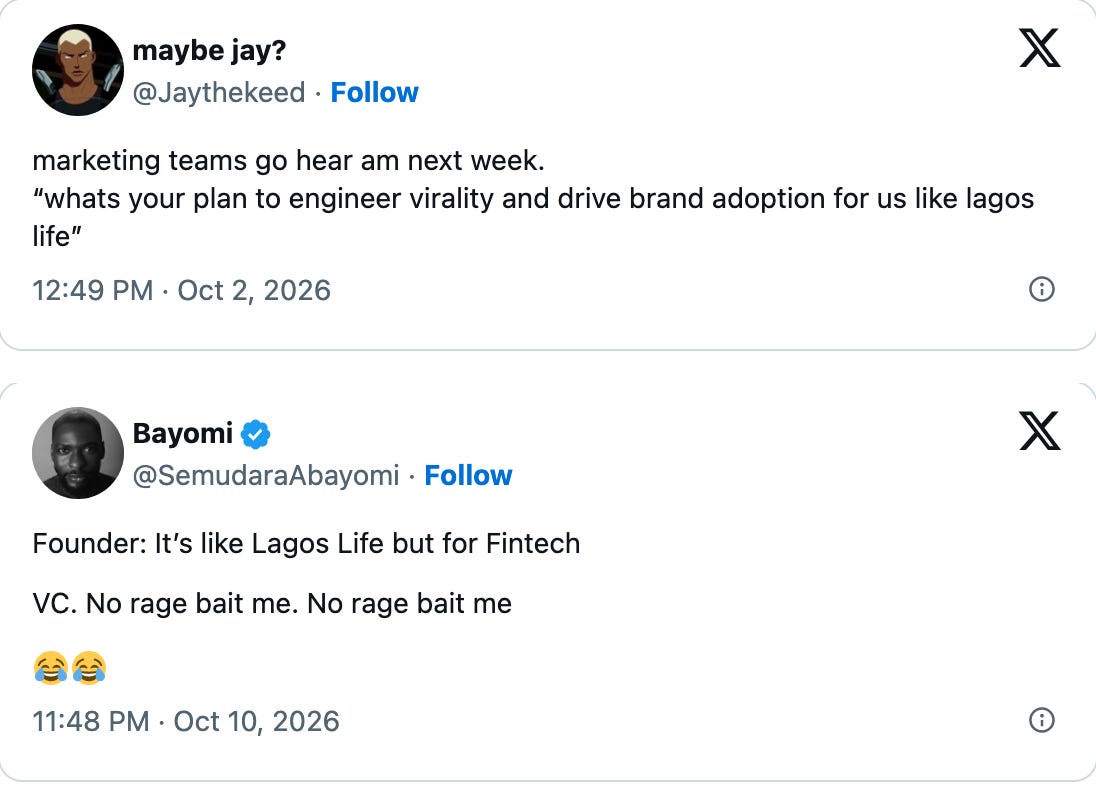
On 2 October, Jay (@Jaythekeed) predicted that marketing teams would soon be asked for a plan to "engineer virality and drive brand adoption" for a brand "like lagos life". On 10 October, Bayomi (@SemudaraAbayomi) joked about a founder pitching "Lagos Life but for Fintech" and a VC begging not to be rage baited. The joke drew engagements. Every founder now wants a viral loop by Friday, and every solo developer wants a free weekend project to turn into a company.
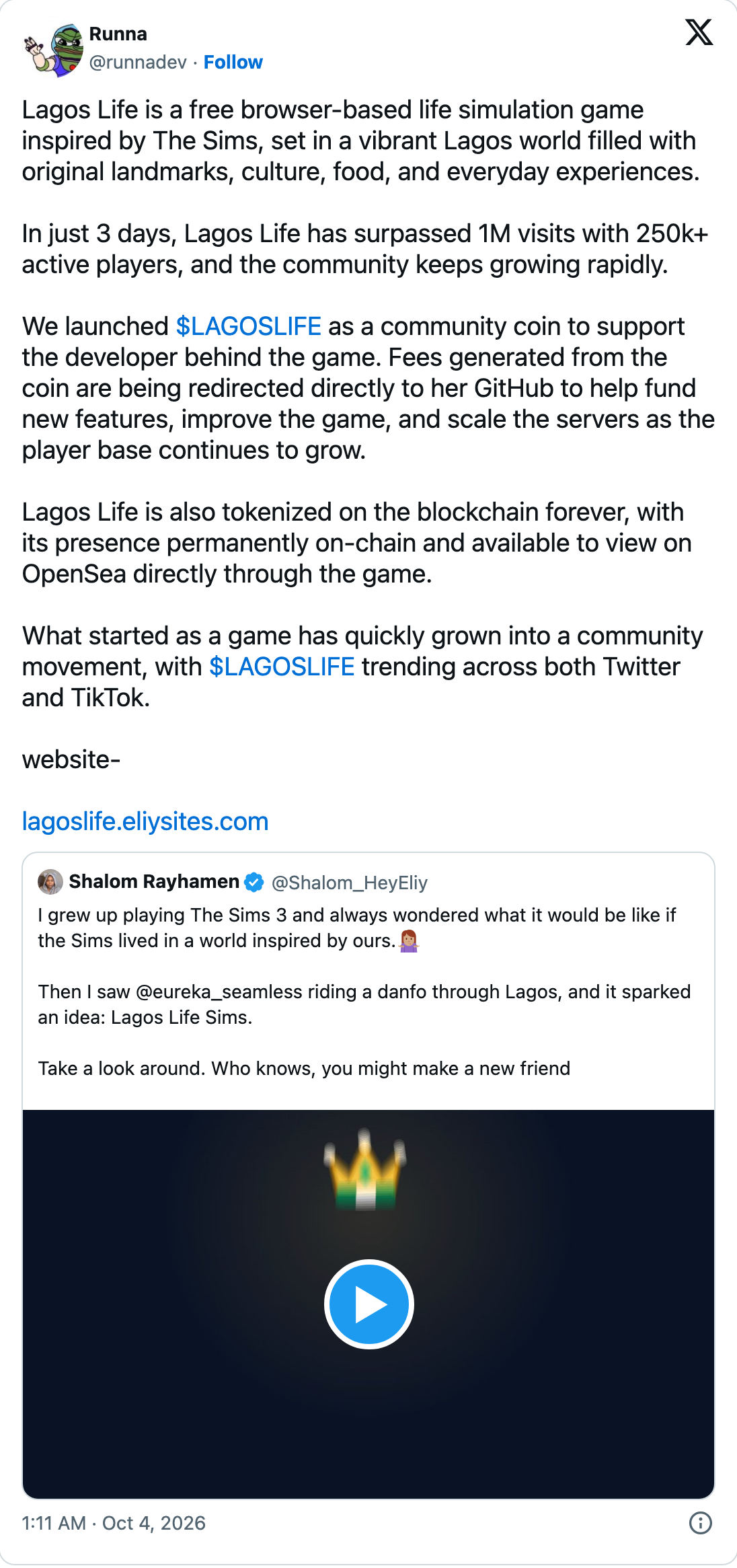
Then came a token.
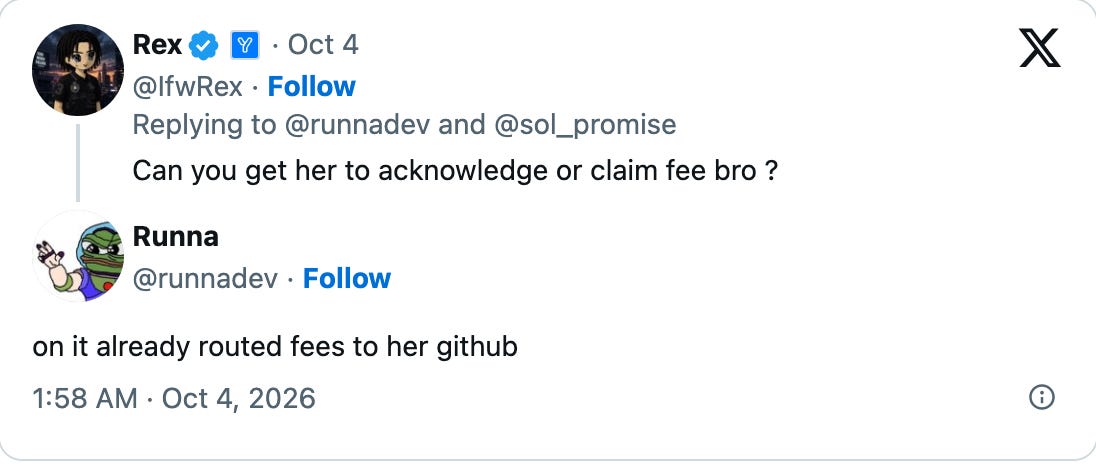
At 1:11 a.m. on 4 October, Runna (@runnadev) announced $LAGOSLIFE, "a community coin to support the developer behind the game", and said its fees were "being redirected directly to her GitHub". GitHub is where developers keep their code. It is an unusual place to keep a salary.
Forty-seven minutes later, Rex (@IfwRex) asked whether Runna could get her to "acknowledge or claim" the fee. Runna replied that the fees were "already routed" to her github. The coin carried her game's name and quoted her launch post, and people in the replies were asking whether she knew it existed.
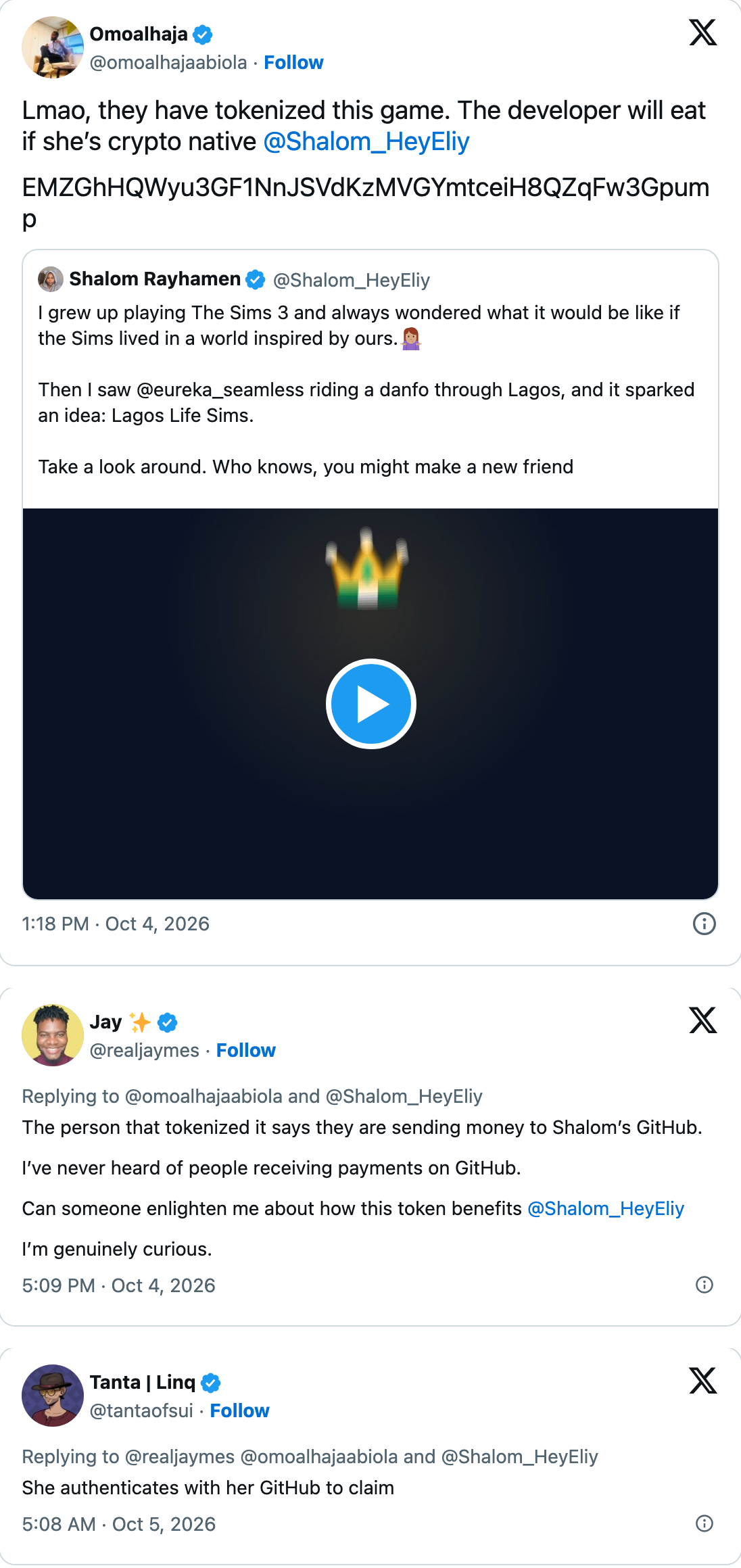
Later that day, Omoalhaja (@omoalhajaabiola) posted the token's contract address, tagged Shalom, and said the developer "will eat" if she were crypto native. I wrote that the person who tokenized it said they were sending money to her GitHub, and that I had never heard of people receiving payments on GitHub. Tanta (@tantaofsui) replied the next morning, "She authenticates with her GitHub to claim". That answers a login question. It leaves the payment question open. On 10 October I asked which platform she would authenticate with. Nobody answered. I am still waiting till today.
Hype attracts people who want to borrow it. If your product takes off, expect your name on things you did not make, and decide early how you will say so in public.
Did the copycats catch up?
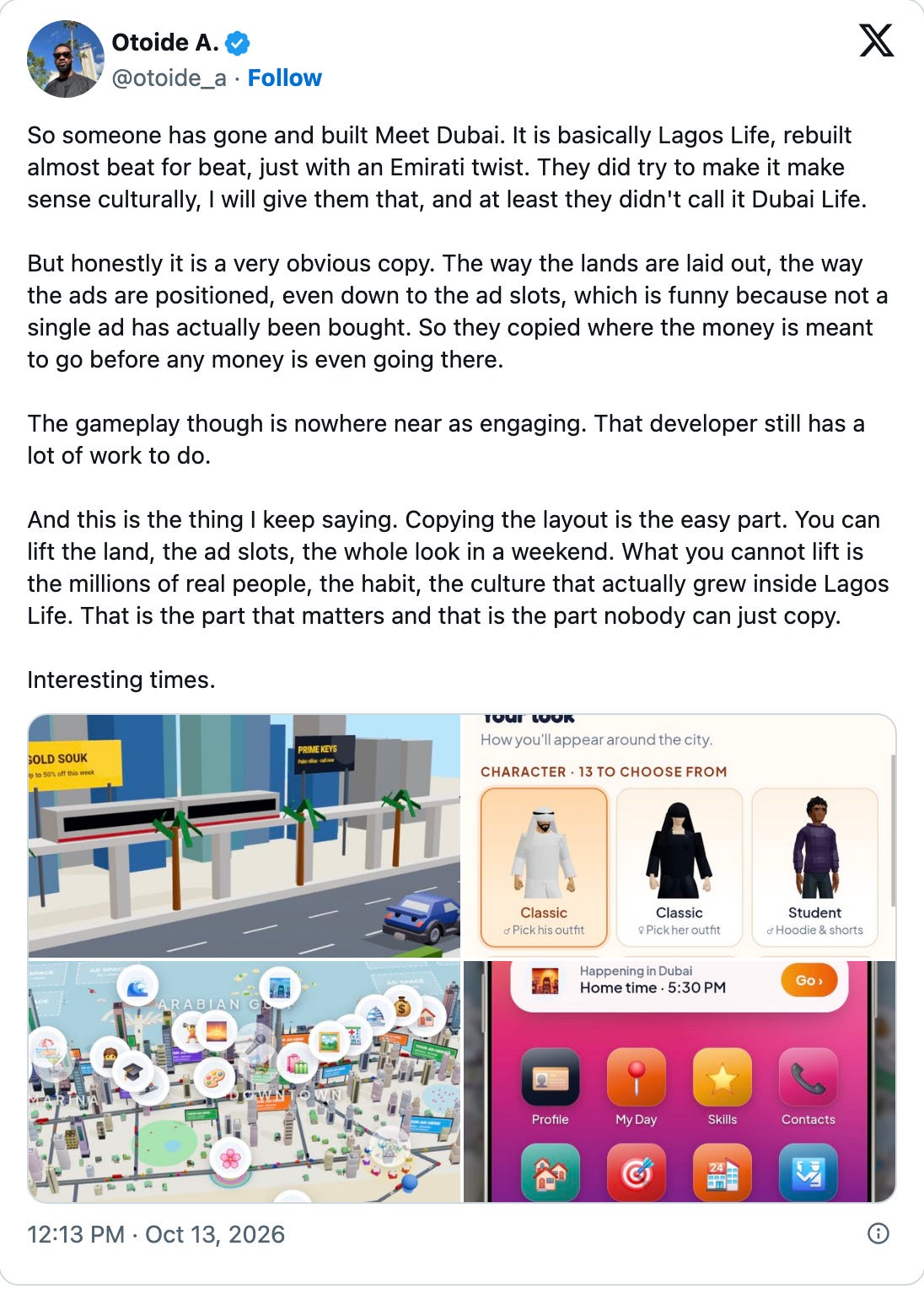
Copies arrived on schedule, because the copycat market rarely misses a deadline. Techpoint lists London Red Bus, released on 1 October, and PH Lifestyle, whose launch post passed 500,000 views. On 13 October, Otoide A. (@otoide_a) wrote that someone had built Meet Dubai, "basically Lagos Life, rebuilt almost beat for beat". HolyProfWeb adds Kano Life, Accra Life and AbujaLife.
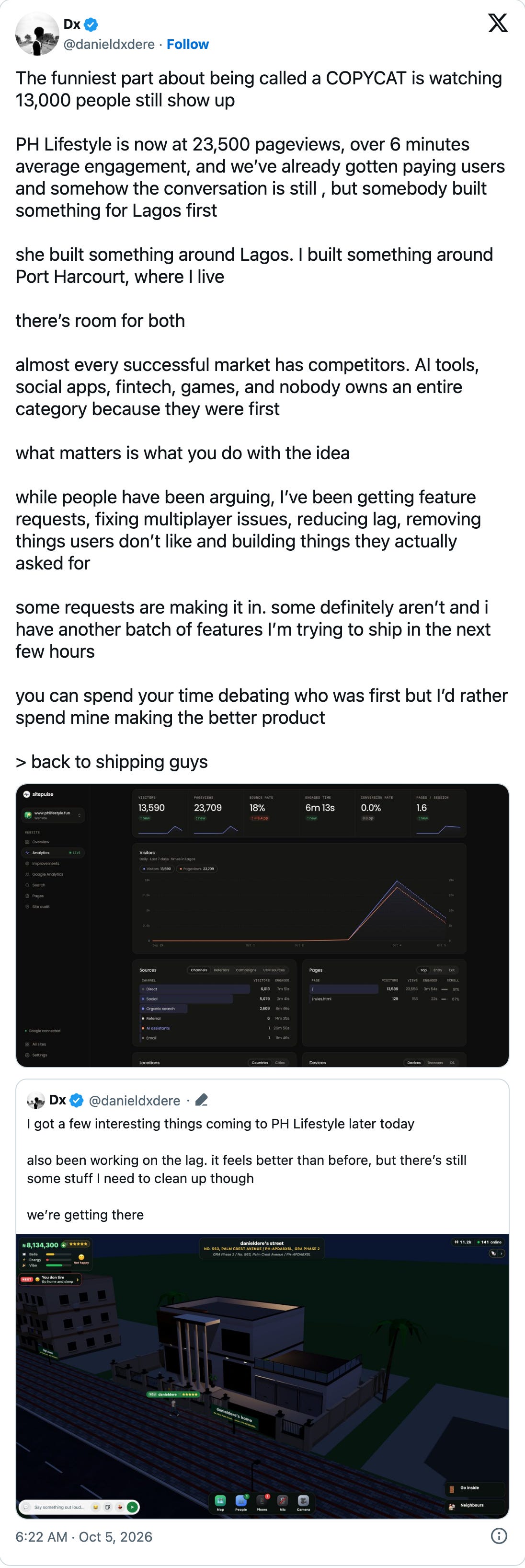
One copycat answered back. Dx (@danieldxdere), who built PH Lifestyle around Port Harcourt, replied to the label on 5 October with his own numbers: 13,000 people, 23,500 pageviews, more than six minutes of average engagement and paying users already. "she built something around Lagos. I built something around Port Harcourt, where I live," he wrote. "there's room for both". By 20 October he was shipping Kalabari etibo and Okrika outfits. No Lagos game was going to make those for him.
A developer can copy the premise, the browser link and the map in hours. London Red Bus's developer says he built his the morning after seeing Danfo Run. What a copy cannot bring along is the first crowd, a founder posting every milestone, and advertisers already inside. Lagos Life was a remix too, of The Sims and of Danfo Run. Even the danfo had been driven before. ChopUp Games built a Danfo series for Java feature phones and BlackBerry, and TechCabal reported in 2015 that it had been played by more than 700,000 users.
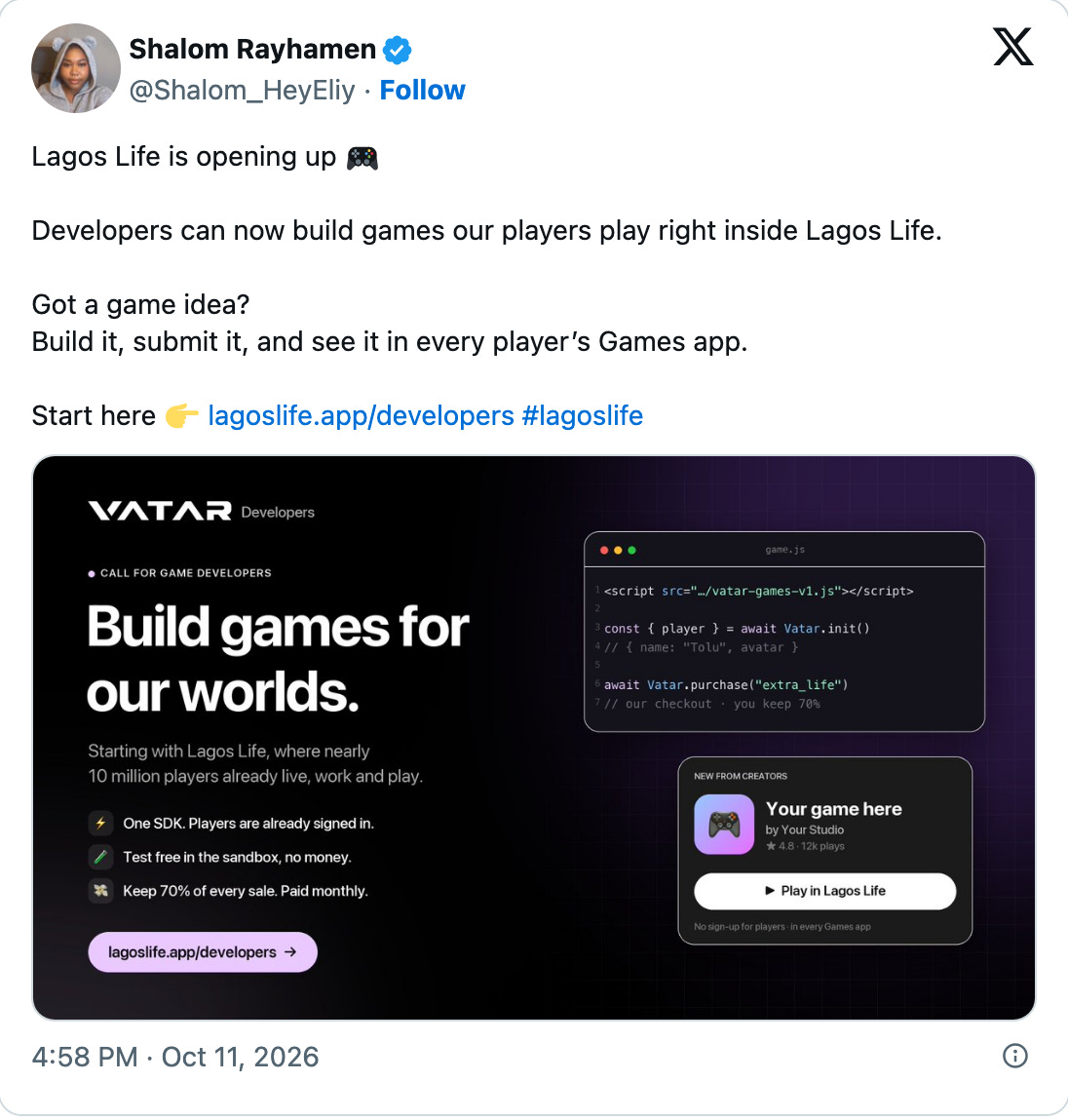
Her own answer was to invite them in. On 11 October she opened the game to outside developers: "Build it, submit it, and see it in every player's Games app." Builders keep 70% of every sale, so a rival who builds inside Lagos Life becomes a supplier.
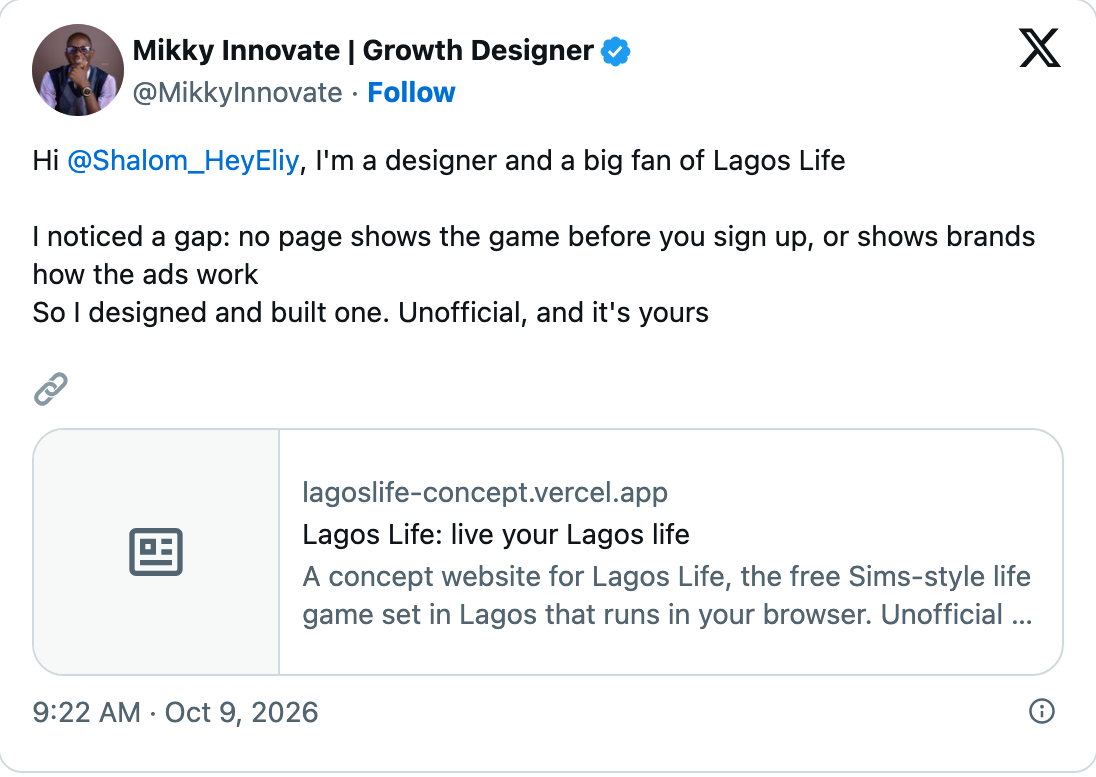
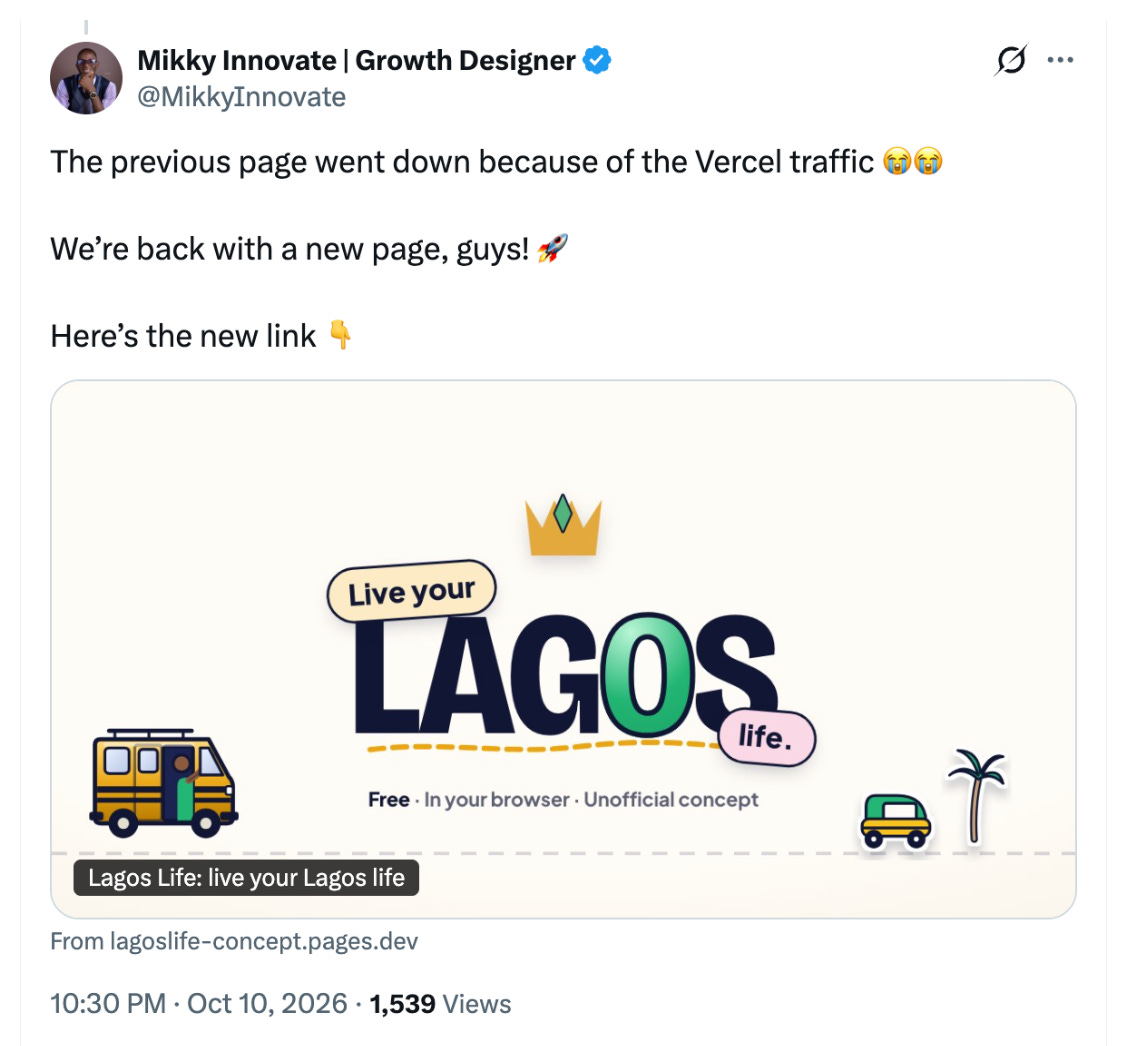
Some builders needed no invitation. Mikky Innovate (@MikkyInnovate), a growth designer, built an unofficial landing page for the game and offered it to Shalom on 9 October. The post drew 3,200 likes, and I called it ridiculously amazing. The next evening the page was gone. "The previous page went down because of the Vercel traffic," he posted, with a new link. Lagos Life had so much traffic that even its fan site needed a second server.
What can marketers learn from Lagos Life, and what is still unproven?
1. Describe the product in one sentence
"The Sims, set in Lagos" tells you what the game is before you click. If a stranger cannot repeat your pitch after one post, they will not click, and your positioning deck does not count as a stranger.
2. Let people start without a download
Players clicked a link and were inside. In a market where data and phone storage are tight, each extra step is a chance to lose someone.
3. Give players a reason to invite friends
A shared world is better with more people in it. If inviting another person adds nothing, expect sharing to slow once the launch noise dies down.
4. Start making money while people are still talking
The game was free to play, and it was earning within days of launch. Shalom sold billboards, brand partnerships, music promotion and Game Naira top-ups while the game was still trending, and she raised ad prices in the first week. That early revenue gave investors something real to look at, and the round closed in a day. Attention after a launch fades fast, so decide how you will charge before it arrives. This MIA playbook on building a viral loop before you launch covers the full method, revenue included.
5. Answer your audience in public
"You asked for your cities. We built them" is a feature and an advert in one sentence, and it invites the next request.
6. Rent attention before it gets crowded
The same board went from about ₦5,000 a week to ₦250,000. Brands that built a hunt or a DJ set got more than a logo.
7. Invite the copycats in
You cannot stop a clone from appearing. You can give builders a place inside your product and a share of the sales.
8. Let AI shorten the build, and spend the time on skill and the audience
A tool that lets one developer ship in a night shortens it for everyone. Years of practice decided whose night worked.
The public numbers still leave one question: did the players stay? A sign-up count shows how many people tried the game. It cannot show how many stayed. She posted 9.3 million on 11 October, and the live feed read 11,500,000 on 27 October. About 5 million were added between 8 and 11 October, about 2.1 million in the ten days to 21 October, and about 100,000 in the six days after that. Retention is the number to ask for, using the Day 1, Day 7 and Day 30 checks.
At the funding announcement Shalom said what comes next:
"Lagos is just the beginning. We're building entire worlds, and there's so much more to come."
Shalom Rayhamen, funding announcement on X
Investors valued the company at $10 million before any retention data was public. The valuation arrived before the boring spreadsheet. On 22 October, Condia reported that Vatar was in talks to raise $2.5 million at a $15 million valuation, and the retention numbers were still not public. If you want to test your own product against the same checks, the 14-point scorecard in this MIA playbook on viral loops is a good place to start.
If your boss asks you for a Lagos Life moment by Friday, forward this first. It buys you until Monday.
If you want to collaborate or feature your product in this newsletter, check out our media kit, and shoot me an email.
What do you think about this story?
Very good breakdown.
Love it 👏