



Thanks for reading MIA—everything you need to put marketing into action—templates, frameworks, community, data, insights, case studies, ideas, and martech/GTM tools. Share it with your network! ~James
A few months ago, Techpoint Africa published a piece naming what’s already underway: Nigerian fintechs are rebundling. PalmPay. Carbon. Moniepoint. The category that spent the last decade unbundling is bundling itself back together, this time on purpose. The day the article ran, three different operators sent it to me. Each one was inside a multi-product company. Each one was asking the same question: how do we launch the next product without breaking the ones that came before?
That is what Oluwasemiloore Akoni and I spent the last few weeks pulling apart together.
Part 1: The retention and lifecycle side of going multi-product.
Why a single-product retention playbook breaks the moment you ship a second product
How user journeys split into branches in multi-product companies, and what that does to lifecycle marketing
Cross-product activation events as the real signal that users trust the platform
What PiggyVest’s pivot to Investify, Moniepoint’s deliberate sequencing, and OPay’s super-app reset teach about expansion done right and wrong
Part 2 (you are here): How to launch new products without breaking the ones that came before.
Why a second product launch is brand architecture work, not product marketing work
The three-layer messaging system that holds a multi-product company together
The brand architecture decision (branded house, house of brands, or endorsed) every operator eventually has to make
A working framework with thirteen real examples and a fillable template you can copy
A second product launch is a different problem than the first one
A first-product launch is mostly about discipline. You have a hypothesis. You ship the smallest version that proves it. You find the moment a stranger becomes a user, and you make that path so smooth it turns into a habit.
A second-product launch is something else. It’s about continuity. The user already trusts the brand a certain way, and the second product has to fit inside that trust. PiggyVest taught its first users one thing: save your money and don’t touch it. The day Investify launched, the company had to teach the same users to do something that almost sounded like the opposite. Take a matured Safelock balance and put it into a higher-yield investment. Same brand. Same promise. Just a longer time horizon.
This is the part most operators get wrong. They write a new value proposition. They build a new landing page. They broadcast a launch campaign to the whole user base. From the user’s point of view, this looks like two different messages fighting for the same brand. The user doesn’t stop trusting the brand. They just stop being able to say what the brand is for.
Semiloore writes about this from the retention side. The moment a company adds a second product, the user journey splits into branches. There’s the power saver. There’s the investor who only came in for Investify. There’s the casual user the brand picked up from an influencer post. Each one reads the same launch from a different starting point. How to actually run that launch, given those different starting points, is what this article is about.
The MIA Academy runs bootcamps where marketers build skills in product marketing, growth, GTM, and AI while working on real projects. Learn more about the bootcamp here.
The fragmentation trap most operators fall into
The fragmentation trap is what happens when every product in a company has its own positioning, its own audience, and its own launch campaign, with nothing above them tying everything to a shared meaning. It looks fine inside the building. Each team has done good positioning work. Each landing page passes a teardown. The problem only shows up at the brand level, where two clean product positionings end up competing for the same brand and cancel each other out.
You have to make a brand architecture decision here. Three textbook options. David Aaker laid them out decades ago and the typology still holds:
Branded house. One master brand. Every product lives visibly under it. The core narrative shows up everywhere a customer looks. PiggyVest, Moniepoint, HubSpot, Notion, and Apple all live here. Pick this when your audiences overlap, your brand equity is the main asset, and you want users moving across products.
House of brands. Independent brands, separate identities. The parent stays mostly invisible to the customer. P&G, Unilever, and Reckitt live here. Pick this when your audiences are genuinely different, the brand credibility lives in the category (not the parent), and putting everything under one master brand would crush what each brand has earned.
Endorsed or hybrid. Sub-brands with parent endorsement. Marriott Bonvoy, Toyota and Lexus, Send by Flutterwave, and Carbon and CarbonExpress live here. Pick this when your products share buyer trust but need their own visual or category identity.
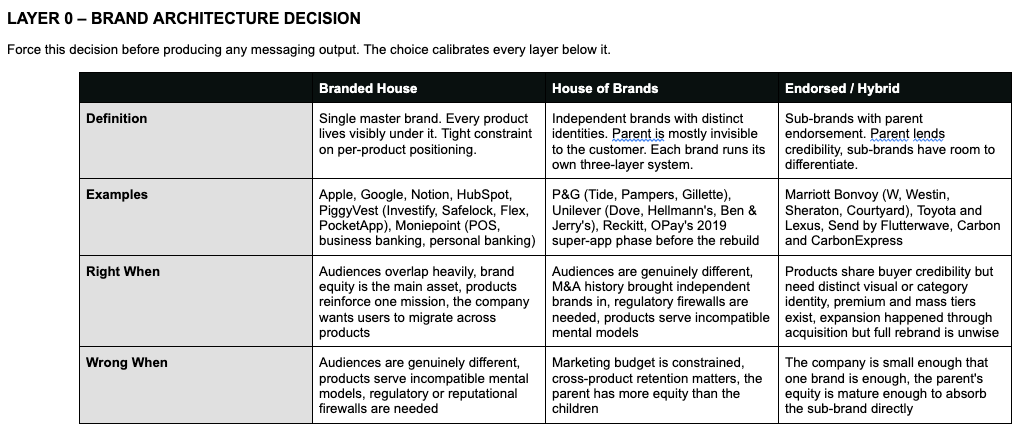
The mistake worth flagging: most operators don’t make this choice on purpose. They drift into one by accident, and the drift is what creates the fragmentation.
Two cases from Nigerian fintech, opposite outcomes.
PiggyVest avoided the trap with restraint. Investify, Safelock, Flex, and PocketApp all live under one master brand, one core narrative (”a digital financial warehouse”), one beginner-friendly tone. None of them got their own brand. What changes between products is the function, not the brand. When PiggyVest launched a new product, the existing user didn’t have to learn a new brand. They learned a new room inside a house they already lived in.
OPay’s 2019 super-app expansion fell straight into the trap. ORide, OFood, OCar, and OExpress each needed its own marketing engine and its own visual identity. The “O” prefix made them look like a family, but the family didn’t share a story. A motorcycle passenger paying for an ORide didn’t see herself as someone adopting a digital wallet. When the 2020 Lagos motorcycle ban and COVID forced a dismantling, OPay rebuilt around payments as a single, tighter branded house. The company came out stronger because the reset finally made it clear what OPay was actually for.
If you can’t tell me in one sentence which architecture your company is, you’re drifting. Stop. Make the call. The next launch depends on it.
Which architecture is your company in: branded house, house of brands, or endorsed?
The core narrative is the unit of work
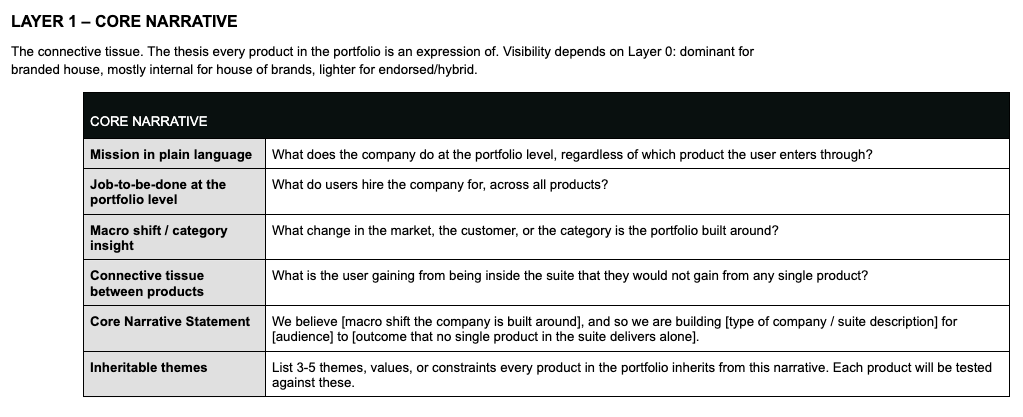
The fix for the fragmentation trap is to stop treating product-level positioning as the most important work, and start treating the core narrative at the suite level as the layer everything else hangs on.
A core narrative isn’t a tagline. It isn’t a brand promise. It’s the single thesis your whole portfolio is an expression of. Every product in the suite has to inherit something from it. The core narrative answers two questions a positioning statement doesn’t. What ties this product to the rest of the suite? And what does a user gain from being inside the suite that no single product gives them on its own?
PiggyVest’s is “a digital financial warehouse for the user whose financial life is too complex for one product.” Moniepoint’s is closer to “infrastructure that makes running a business invisible.” Apple’s is “computing should disappear into the experience.” Each one is short. Each one is a real thesis, not a slogan. And each one is strong enough to hold five or fifty products under it without any of them pulling against the center.
If you can’t write yours in one or two sentences, you don’t have a portfolio yet. You have a list of products that share a logo. The work of the next launch is to find the narrative that turns the list into a portfolio. Then you ship the new product into that.
Three layers of messaging that have to inherit downward
Once the core narrative exists, the rest of the messaging system falls into a hierarchy.
Layer 1: the core narrative. One to two sentences. Sits at the top. Shows up on the homepage, in investor decks, and at the top of every product page. Doesn’t change when a new product ships.
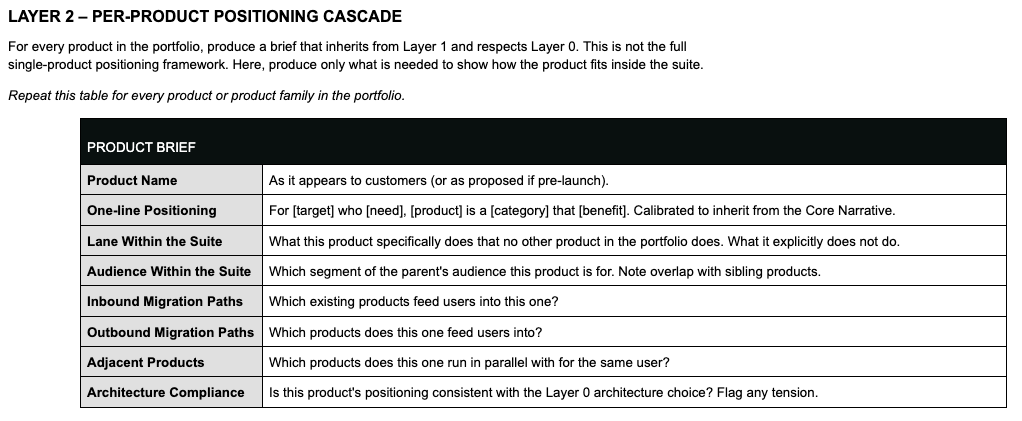
Layer 2: per-product positioning. Each product has its own positioning brief that inherits from Layer 1 and owns its specific lane.
Layer 3: feature-level messaging. Buttons, empty states, onboarding screens, feature announcements. Inherits from product positioning. Never breaks the core narrative. The rule at this layer is keep it tight.
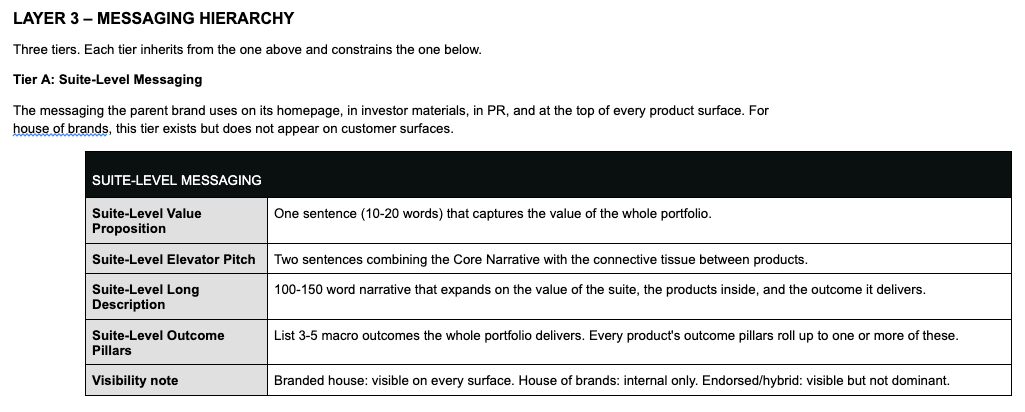
The chain matters because it’s the only way a suite scales without breaking apart. Each layer constrains the one below and inherits from the one above. When the chain breaks, the suite falls apart. If you have a multi-product company and these three layers aren’t documented anywhere, that’s the most important next thing to do.
Want to actually run frameworks like this on real products? The Product x Growth x AI Bootcamp teaches applied product marketing, growth, GTM, and AI through real execution, feedback, and systems you can use at work.
What this looks like across Nigerian fintech (and Notion)
Six cases. Five Nigerian fintech, one SaaS extension to prove the model travels.
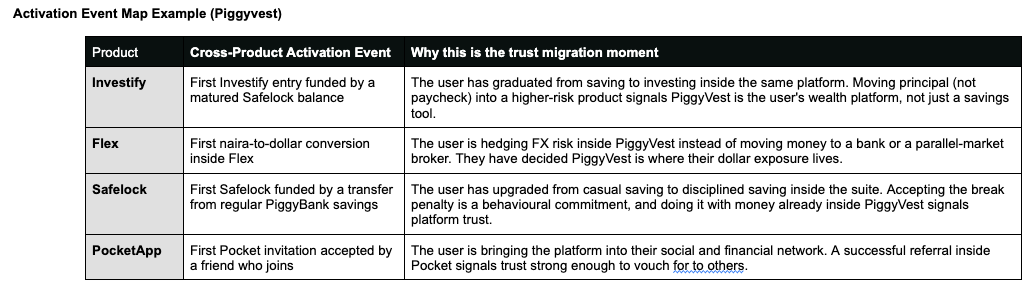
PiggyVest runs the cleanest branded house in Nigerian fintech. The cross-product activation event (the action a user takes that proves a new product is now part of their relationship with the platform, not just something they tried once) most worth tracking is the first time someone takes a matured Safelock balance and puts that money into Investify. That’s the moment they stop being just a saver and start being a user of the whole platform.
Moniepoint runs the most deliberate sequencing in Nigerian fintech. POS terminals, then agent banking, then business banking, then credit, then personal banking. Each step earns the next. The activation event that proves the architecture is working is the first business loan a merchant gets approved for, based purely on how much money has flowed through their POS. Trust earned in payments turns into willingness to borrow.
OPay is the cautionary case. The 2019 super-app phase tried to be a house of brands without the marketing budget or the audience clarity to back it up. The 2020 reset rebuilt around payments as a single, tighter branded house. The lesson here isn’t that OPay was wrong to expand. The lesson is that the architecture choice was never made on purpose, the core narrative was never written down, and the fragmentation followed automatically.
PalmPay and Carbon are the live cases right now. PalmPay is consolidating around a single consumer brand and behaving like a branded house. Carbon has gone endorsed-hybrid: the main Carbon banking experience and the CarbonExpress rapid-loan product sit side by side as sibling brands under the same parent.
Notion is the non-fintech case that proves this model isn’t Nigerian-specific or fintech-specific. It’s a branded house that keeps stretching to fit new products without breaking. Notes, docs, projects, calendar, and mail all started as features and grew into their own products inside one connected workspace. When Notion Mail launched in 2025, existing users didn’t have to learn a new brand. They learned a new surface inside a workspace they already lived in. It’s the same move PiggyVest made when it launched Investify. Different category, different country, same architecture, same discipline.
Sequencing the launch itself
The framework above describes the system. The launch is what happens when you ship a new product into that system. Three moves, in order.
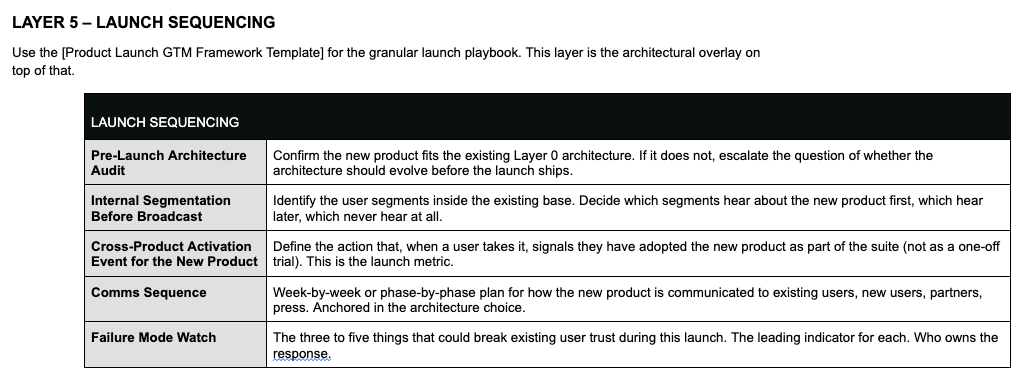
Internal segmentation before broadcast. Before any external announcement goes out, decide which segments of your existing user base hear about the new product first, which hear later, and which never hear at all. The power saver and the casual user you got from an influencer post are reading the same launch from completely different starting points. Ship the launch to the segment that already understands what the new product is for. Then expand from there.
Define the cross-product activation event, not feature adoption. The metric most operators track (the number of users who tried the new product) is misleading. The number that actually tells you the launch worked is the action that proves the new product is now part of the user’s relationship with the platform. For a hypothetical PiggyVest credit launch, that would be “first credit loan backed by their Safelock savings,” not “first credit signup.” The first one proves the user has migrated their trust. The second one only proves they were curious.
Sequence the comms so existing users opt in. A second-product launch isn’t a press release. It’s a conversation that happens inside the product, inside lifecycle email, and inside the user segments where the new product fits. The press release exists to tell partners, regulators, and the market. The growth comes from the conversation.This article goes deep on the launch playbook itself. Everything above sits on top of that.
The operating tool
Everything above is the framework. Here’s the runnable version.
I built the /portfolio-positioning skill so this article runs as code, not just as theory. It has three modes. architect builds the framework from scratch for a multi-product company. diagnose audits an existing portfolio and scores each layer 1 to 10, plus a total coherence score out of 40. launch sequences a new product into an existing portfolio with the architectural overlay already built in.
The skill ships with a fillable framework template that walks you through every layer. It includes thirteen worked examples. PiggyVest, Moniepoint, Notion, HubSpot, and Apple as branded houses. P&G, Unilever, Reckitt, and OPay’s 2019 super-app phase as house of brands cases. Marriott Bonvoy, Toyota and Lexus, Send by Flutterwave, and Carbon and CarbonExpress as endorsed or hybrid cases.
The skill works with four others in the marketingagentskills repo. Run /icp-persona per product to map audiences. Run /product-positioning per product after Layer 1 is set. Run /product-messaging per product after suite-level messaging is documented. Run /product-launch-gtm for each new launch.
If you use Claude Code, install the skill from the repo. If you use ChatGPT or another assistant, the framework template stands alone and can be copied into any AI tool.
Thanks for reading. The framework is yours. Go ship.
📣 Share this with a founder or marketer on Twitter | LinkedIn | WhatsApp. It takes me 20 hours to write this. Sharing will only take 20 seconds.
TL: DR
Get a PDF summary of this article here.
A first-product launch is about discipline; a second-product launch is about continuity inside the trust the user already has.
Launch a second product like the first and the user stops being able to say what the brand is for.
The core narrative is the single thesis your whole portfolio is an expression of, like PiggyVest’s “digital financial warehouse.”
Multi-product messaging runs as a three-layer hierarchy: core narrative, per-product positioning, feature-level messaging.
The brand architecture choice (branded house, house of brands, or endorsed/hybrid) sits above the three layers, and most operators drift into one by accident.
Sequence the launch in three moves: segment internally before broadcast, track cross-product activation events, and run the comms so existing users opt in.
Was this helpful? Hit that ❤️ and let me know your thoughts in the comments! Want to see more of this content? Restack this post (if you’re on Substack) and share it with your friends!
You might find these interesting:
MIA #13: How to Plan Smarter Product Launches That Win (+ Template) – The launch sequencing playbook this article extends. Required reading if you want the granular launch checklist beneath the architectural overlay above.
Nigerian fintechs are rebundling financial services (Techpoint Africa) – The Techpoint piece that triggered this collab. Names the rebundling shift across PalmPay, Carbon, Moniepoint, and the macro forces driving it.
If you want to collaborate or feature your product in this newsletter, check out our media kit, and shoot me an email.
MIA is trusted by 2,000+ marketers across Africa, the US, and Europe, helping you put marketing in action better, faster, and with context.
We’re building a village of marketers and founders who want to increase their odds of succeeding at marketing. You’re one of us. Share this newsletter with them.